Best Cat Treats: Calories per Piece and the Label Line That Matters
Four cat treats judged on calories per piece, the adequacy line on the bag and what each is for, with the 10 percent treat budget worked out for a 10 lb cat.
By Tess Lindqvist, writer, cat products and everyday health
Published Oct 16, 2026 · 12 min read
- Cat Food
- 4 products compared
In this guide
A cat treat is judged on a different scale from a cat food. Nobody needs a treat to be complete, and most are not. What a treat needs is a calorie count small enough to fit inside the allowance, a format that suits the job you are giving it, and a label that says honestly whether it can stand in for a meal.
That allowance is smaller than most owners assume. Tufts' Petfoodology service, written by veterinary nutritionist Deborah Linder, puts it at 10 percent of daily calories and gives 300 calories a day as the average for a 10 lb cat. That makes 30 calories of treats, total, for the whole day. Cornell's Feline Health Center sets its ceiling at 10 to 15 percent of daily intake and calls obesity the most common nutrition-related problem in cats.
So the four picks below are ranked by what they do inside that 30-calorie budget. Prices are Amazon's on 16 October 2026, with the pack size beside each one, because treat bags range from a single ounce to a pound and the sticker price alone says nothing.
What separates a good treat from a bad one
Calories per piece, not per bag. The label has to state calorie content in kilocalories per kilogram, according to AAFCO, and most treat makers also print a per-treat figure. That second number is the useful one. A treat at 1.4 calories lets a cat have twenty a day. A lickable tube at 6 calories allows five.
The adequacy line. AAFCO says treat products "aren't usually intended to provide a complete and balanced diet," and its rules do not require them to meet nutritional adequacy standards. A bag that says "for intermittent or supplemental feeding only" is telling you, in AAFCO's words, that it does "not meet any of the normal standards for complete and balanced nutrition." Two of the treats here are complete and balanced for adult cats, and two are not. That difference matters mostly to the owner who hands out treats by the handful.
What the treat is for. A training reward wants something small, strongly scented and quick to eat. A treat for giving a pill or for a cat that is wary of being handled wants something the cat will lick from your hand. A dental treat is a different product with a different job, and only one category of treat has an outside body checking the claim on the bag.
The total, not the treat. A low-calorie treat fed in large numbers is a high-calorie habit. Every pick below states its feeding guide, and in two cases the maker's own suggested daily amount uses most of the 30-calorie budget by itself. Working out a specific cat's real daily figure is covered in how much to feed a cat.
The picks
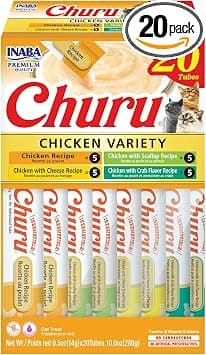
$14.79 for 20 x 0.5 oz tubes
Price checked Oct 16, 2026
INABA Churu Lickable Purée Cat Treats, Chicken Variety Box, 20 x 0.5 oz Tubes
The treat to buy when the point is getting a cat to come to your hand. Churu is a chicken purée squeezed from a tube, and the cat licks it straight from the end, which makes it the easiest way to reward a cat during nail trims, carrier practice or a vet's pill schedule. At 91 percent moisture it also adds water. Wrong as a daily habit fed several tubes at a time: each tube carries 6 calories, so five of them spend the full 30-calorie budget for a 10 lb cat, and the guaranteed analysis shows only 7 percent protein because most of what you are buying is water.
We may earn a commission on this link. It never changes the ranking.
- Format
- Lickable purée, 0.5 oz (14 g) tubes
- Calories
- 430 kcal/kg, 6.0 kcal per tube
- Guaranteed analysis
- Protein 7% min, fat 0.2% min, moisture 91% max
- In the box
- 20 tubes across chicken recipes, including chicken with scallop
- Made in
- Thailand
What works
- Licked from the tube, so it rewards a cat at exactly the moment you need
- Very high moisture, which suits cats that drink little
- Soft enough to wrap around a small pill or capsule
- No grain in the recipe
What to know
- Six calories a tube, so the budget runs out after five
- Low protein as fed, because the tube is mostly water
- Messy if the cat pulls away mid-lick
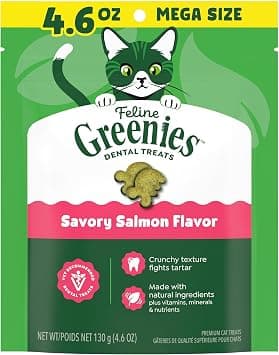
$5.48 for a 4.6 oz pouch
Price checked Oct 16, 2026
Greenies Feline Natural Dental Cat Treats, Savory Salmon Flavor, 4.6 oz
The only treat here whose dental claim an outside body has accepted. Feline Greenies appear on the Veterinary Oral Health Council's accepted list for tartar, with the seal awarded in 2005, and the list makes no plaque claim for them. At 1.4 calories a treat they are also the lightest per piece of the four. The catch is the dental feeding guide: the maker suggests 8 treats twice a day for a 10 lb adult cat, which is 22.4 calories, three quarters of the whole treat budget. Wrong for kittens under a year, which the maker excludes, and wrong as a substitute for brushing, which remains the standard.
We may earn a commission on this link. It never changes the ranking.
- Format
- Crunchy shaped dental treat
- Calories
- 3477 kcal/kg, 1.4 kcal per treat
- Guaranteed analysis
- Protein 27% min, fat 12% min, fibre 10% max
- VOHC
- Accepted for tartar, seal awarded 2005
- Age
- Cats 1 year and older
What works
- One of only a handful of cat treats on the VOHC accepted list
- Low calorie per piece
- Inexpensive per pouch
- Crunchy enough that cats chew rather than swallow whole
What to know
- The dental dose takes most of a 10 lb cat's treat budget
- Not for kittens under a year
- Tartar acceptance only, not plaque
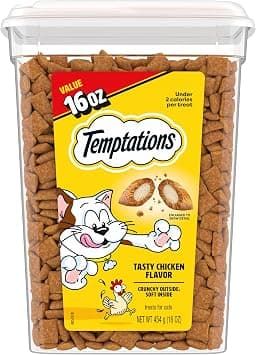
$6.49 for a 16 oz tub
Price checked Oct 16, 2026
Temptations Classic Crunchy and Soft Cat Treats, Tasty Chicken, 16 oz Tub
The value pick, and one of the two here that are complete and balanced for adult cats, so a cat that gets more than planned is at least eating a full diet. Each piece is a crunchy shell around a soft centre at under 2 calories, cats respond to the rattle of the tub, and a 16 oz tub lasts a long time. Wrong for an owner who wants a short ingredient list: chicken by-product meal and ground corn lead it. Wrong too for anyone following the tub's guide without arithmetic. Its 11 to 13 treats per 10 lb a day lands at up to 26 calories, nearly the whole budget.
We may earn a commission on this link. It never changes the ranking.
- Format
- Crunchy shell, soft centre
- Calories
- Under 2 kcal per treat
- Guaranteed analysis
- Protein 28% min, fat 21% min, moisture 10% max
- Adequacy
- Complete and balanced for adult cats
- Feeding guide
- 11 to 13 treats per 10 lb of body weight daily
What works
- Complete and balanced, unlike most treats
- Cheapest per ounce of the four by a wide margin
- Small pieces suit training repetitions
- Strong acceptance, and the shaken tub works as a recall cue
What to know
- By-product meal and corn lead the ingredient panel
- The suggested daily amount nearly fills the treat budget
- Fat at 21 percent minimum is high for an overweight cat
$10.99 for a 1.0 oz bag
Price checked Oct 16, 2026
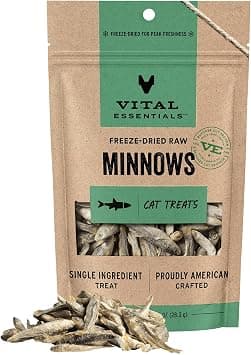
Vital Essentials Freeze Dried Minnows Cat Treats, 1.0 oz Bag
One ingredient, minnow, freeze-dried whole, at 2 calories a treat and 60 percent minimum protein. For a cat eating a limited diet where every extra ingredient matters, a treat with a one-word panel is the easiest to clear with the vet. Wrong for any household with a kitten, a pregnant person or anyone immunocompromised: these are sold as freeze-dried raw, and Cornell's Feline Health Center does not recommend raw meat as a food or a treat for cats because it can carry toxoplasmosis and other infections. Wrong too for anyone shopping on price. A single ounce costs more than a pound of Temptations, and the bag says intermittent or supplemental feeding only.
We may earn a commission on this link. It never changes the ranking.
- Format
- Whole freeze-dried minnows
- Ingredients
- Minnow
- Calories
- 2892 kcal/kg, 2 kcal per treat
- Guaranteed analysis
- Protein 60% min, fat 5% min, moisture 8% max
- Adequacy
- Intermittent or supplemental feeding only
What works
- A single ingredient, which simplifies a restricted diet
- High protein and low fat per piece
- Light at 2 calories a treat
- Whole fish appeals to cats that ignore flavoured treats
What to know
- Raw, which Cornell advises against for cats
- Most expensive per ounce of the four by far
- Some cats used to strongly flavoured treats ignore it at first
How they compare
| Treat | Calories per piece | Complete and balanced | Best for |
|---|---|---|---|
| INABA Churu, Chicken Variety | 6.0 per tube | No | Pills, handling, nervous cats |
| Feline Greenies, Salmon | 1.4 | Yes, adult cats | Tartar control, VOHC accepted |
| Temptations Classic, Chicken | Under 2 | Yes, adult cats | Everyday rewards on a budget |
| Vital Essentials Minnows | 2 | No | Single-ingredient reward |
Who each one is wrong for
An overweight cat is the case where the arithmetic decides everything. Cornell names obesity as the most common nutrition-related problem in cats, linked to arthritis and diabetes. For that cat the lightest treat per piece wins, given in a counted number, with the meal reduced to make room. The maker's guide on the Greenies bag says to adjust the main meal to compensate for treat calories, which is the rule for every treat here, not only that one.
A cat with a diagnosed condition on a prescription or limited diet should get treats only once the vet has agreed to them. A single extra protein can undo a food trial, and a lickable tube with several recipes in one box is the wrong choice there.
A kitten should get its calories from a growth food, so treats stay few and small. The Greenies are excluded under a year by the maker, and the raw minnows are wrong for a kitten for the reasons Cornell gives. Choosing that growth food is covered in the best kitten food.
A cat that has stopped eating is not a treat problem at all. Offering tubes to a cat that refuses its food can mask a medical issue for days.
Getting more from fewer treats
Break the crunchy ones. A Temptations piece or a Greenie snapped in half is still a reward, and a training session of twenty half-pieces costs ten treats' worth of calories. Lickable tubes stretch further when squeezed onto a plate in small dabs than when the cat finishes a full tube in one go.
Take treat calories out of the meal, not on top of it. If a cat gets 20 calories of treats a day, its food portion drops by about 20 calories, and over a year that difference is the gap between a stable weight and a slow gain. Human food counts against the same budget. Tuna, the most common one, has its own risks beyond calories, set out in can cats eat tuna.
Read the panel before the front of the bag. The calorie content, the adequacy line and the ingredient list are where the product says what it is, and they are the same three things that matter in a full meal, as explained in reading a cat food label. For raw and freeze-dried products specifically, the bird flu cases in raw cat food are the other reason to read where a treat was made and how.
Questions people actually ask
How many treats can a cat have a day?
Under the Tufts rule, treats should be no more than 10 percent of daily calories. For a 10 lb cat eating about 300 calories, that is 30 calories of treats: around 20 Greenies, 15 Temptations or five Churu tubes. Cornell allows 10 to 15 percent. Either way, cut the meal by the same amount.
Are lickable cat treats healthy?
They are mostly water and fine in moderation. A Churu tube is 91 percent moisture and 6 calories, and the box does not claim to be a complete diet. The concern is quantity, because several tubes a day use up the whole treat budget quickly.
Do dental treats for cats work?
Feline Greenies are accepted by the Veterinary Oral Health Council for tartar control, which means the maker submitted data the council reviewed. That is a narrower claim than cleaning teeth, and brushing remains the standard. Few cat treats have any VOHC acceptance at all.
Can treats replace a meal?
Only a treat labelled complete and balanced for the right life stage could, and even then it is an expensive and poorly portioned way to feed a cat. A treat labelled for intermittent or supplemental feeding only should never be the main diet.
Are freeze-dried raw treats safe for cats?
Cornell's Feline Health Center does not recommend raw meat as a food or a treat for cats, citing toxoplasmosis and other infections. Freeze-drying is not cooking. If you choose one, keep it away from kittens and anyone with a weakened immune system, and ask your vet first.
Sources
- Tufts Petfoodology: treat options for dogs and cats without unbalancing their diet (Deborah Linder, 2021)
- Cornell Feline Health Center: feeding your cat
- Cornell Feline Health Center: anorexia
- AAFCO: reading pet food labels
- Veterinary Oral Health Council: accepted products
- INABA Churu Chicken Variety, 20 tubes: ingredients, guaranteed analysis and calorie content
- Greenies Feline Savory Salmon: calorie content and feeding guide
- Temptations Classic Tasty Chicken: guaranteed analysis and feeding directions
- Vital Essentials Freeze-Dried Minnows: guaranteed analysis and calorie content
As an Amazon Associate we earn from qualifying purchases. We earn a commission on some links, at no extra cost to you. It never changes which products we recommend or the order they appear in. Full disclosure

Who wrote this
Tess Lindqvist
Writer, cat products and everyday health
Tess Lindqvist writes the cat side of PetGearSearch, plus the health-adjacent categories where a label makes a claim the evidence has to back. The question asked of every product is the one owners actually ask at 3am: will the animal use it, and does it do the thing the box says.
The standard
How this guide was built
- The full product specification, ingredient panel or material spec, read end to end rather than summarised from a retail listing.
- The veterinary and regulatory guidance that applies to the category, cited by name and linked — AAFCO nutrient profiles, WSAVA manufacturer guidelines, the VOHC accepted-product list.
- Aggregated owner reviews at volume across retailers, read for the pattern rather than the anecdote, with deliberate attention to the one-star reports where the failure modes live.
- Every price checked against the live listing on the date printed beside it.