Best Wet Cat Food
Five canned foods judged on the adequacy statement, protein on a dry matter basis, moisture, and whether cats will reliably finish the bowl.
By Tess Lindqvist, writer, cat products and everyday health
Published Jul 9, 2026 · 13 min read
- Cat Food
- 5 products compared
In this guide
Wet food is the easiest meaningful upgrade most cat households can make, and the aisle makes it needlessly hard. Every can promises real meat. Almost none of them make the two claims that decide whether the food is any good, and the guaranteed analysis printed on the side is, as printed, uncomparable to the bag of kibble next to it.
The five below are the ones we recommend. They were chosen on four things: a complete and balanced adequacy statement for the right life stage, protein and moisture converted to a dry matter basis so the comparison is real, an ingredient panel that survives being read closely, and the pattern across owner reports at volume, which for wet food is overwhelmingly about acceptance. A perfect food a cat will not eat is a worse food than a merely good one it finishes.
The rest of our cat food coverage sits behind these picks. One thing this list deliberately does not do is rank by price per can. A 3oz can and a 5.5oz can are not comparable units, and the calorie content statement is the only honest denominator.
What separates a good can from a bad one
The adequacy statement, first and last. Look for either "formulated to meet the nutritional levels established by the AAFCO Cat Food Nutrient Profiles for [life stage]" or "animal feeding tests using AAFCO procedures substantiate...". If the can instead says "for intermittent or supplemental feeding only", it is a topper, not a meal, and a surprising number of premium-looking products in meal-sized packaging carry that phrase. Feeding a cat exclusively on supplemental food is how nutrient deficiencies happen in households that thought they were buying the best.
Protein on a dry matter basis, not as printed. A canned food at 78 percent moisture and 10 percent crude protein is about 45 percent protein on a dry basis, which beats most kibble. Comparing the printed numbers across formats is arithmetic error, and it is the single commonest mistake in this category. The full conversion takes one division.
Moisture is the point. Cats descend from a desert predator with a weak thirst drive, and a dry-fed cat generally runs a lower total water intake even after drinking more. That matters most for urinary and kidney health, which is where the moisture argument is genuinely strong rather than merely plausible.
Texture decides acceptance. Pate, shreds in gravy, mousse and chunks are different products to a cat. Cats form preferences early and defend them, so a household is usually better served by a brand with several textures in one recipe line than by the single highest-scoring pate.
Carrageenan and gums are not the crisis they are described as. They are thickeners, they are permitted, and the evidence for harm at the levels used in pet food is thin. If you would rather avoid them there are options below that do, but it is a preference rather than a safety finding, and treating it as the main selection criterion crowds out the questions that matter.
The picks
from $56.63 for 24 x 5.5oz
Price checked Jul 9, 2026
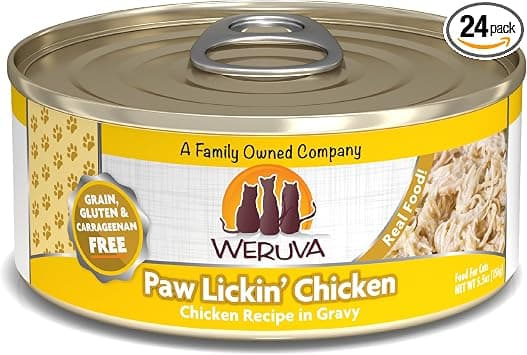
Weruva Paw Lickin' Chicken
The one to buy if hydration is why you are here. Weruva's classic line is shredded white breast meat in a large volume of gravy, which puts it at the very wet end of a wet food category, and cats that pick at pate will often drink the gravy first and eat the rest afterwards. Low fat and low carbohydrate, which suits an indoor cat that does not need the calories.
We may earn a commission on this link. It never changes the ranking.
- Format
- Shredded chicken breast in gravy
- Sizes
- 3oz, 5.5oz, 10oz cans
- Free from
- Grain, gluten, carrageenan, corn, wheat, soy
- Protein source
- Boneless skinless chicken breast
What works
- Very high moisture, which is the main reason to feed wet food at all
- Shredded texture in gravy is accepted by many cats that refuse pate
- No carrageenan or gums, for households that care about that
- Low fat and minimal carbohydrate
What to know
- Expensive per calorie, because a lot of what you are buying is water
- The high gravy fraction means fewer calories per can than the size suggests
- Some cats eat the gravy and leave the shreds, which wastes food
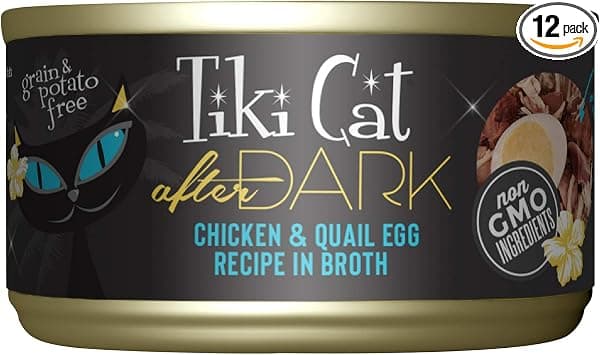
Tiki Cat After Dark Chicken & Quail Egg
Shredded chicken with liver, gizzard and heart plus a whole quail egg, in broth. Organ meat is what a cat eats first in prey and it is nutrient-dense in a way muscle meat is not, so this is the closest thing on the list to the composition a cat evolved on. The pick for a lean, active or young adult cat, and a good option if you are trying to hold carbohydrate down for a diabetic cat under veterinary management.
We may earn a commission on this link. It never changes the ranking.
- Format
- Shredded meat and organ in broth
- Sizes
- 2.8oz and 5.5oz cans, 12 and 24 can packs
- Notable
- Chicken liver, gizzard, heart and whole quail egg
- Carbohydrate
- Minimal, grain free
What works
- Organ meat included rather than muscle meat alone, which is nutritionally the point
- Very high protein and very low carbohydrate
- Strong acceptance among cats that like a shredded texture
- Broth adds moisture without gums
What to know
- Rich enough that some cats get loose stool on a fast switch
- Price per calorie is high
- Availability is patchier than the mainstream brands
from $41.88 for 12 x 5.5oz
Price checked Jul 9, 2026
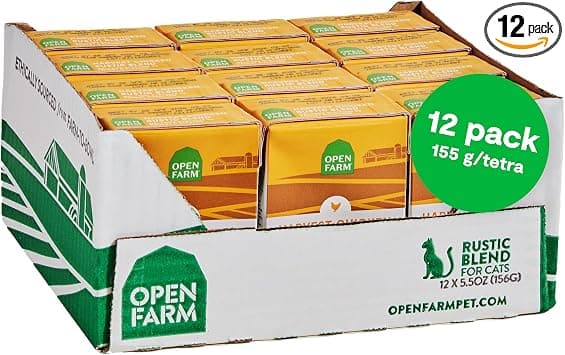
Open Farm Harvest Chicken Rustic Blend
Kettle-cooked chunks of meat with vegetables, grain free and potato free, formulated to meet AAFCO profiles for maintenance. What sets Open Farm apart is traceability: the company publishes sourcing information down to the batch, which almost nobody else in this category does. Buy it if provenance is what you want from a premium price, and note it can be fed as a complete meal or used as a topper on dry food.
We may earn a commission on this link. It never changes the ranking.
- Format
- Kettle-cooked chunks with vegetables
- Size
- 5.5oz packs, sold by the case
- Adequacy
- AAFCO Cat Food Nutrient Profiles, maintenance
- Feeding
- Roughly one pack daily per 5 to 8lb of body weight
What works
- Batch-level ingredient traceability, published rather than promised
- Works as a complete meal or as a topper to raise moisture on a dry diet
- Grain free and potato free
- Human-grade ingredient sourcing
What to know
- Among the more expensive options here per calorie
- Chunk texture is refused by pate-loyal cats
- Case sizes are smaller, so the per-pack price looks high
from $50.08 for 12 x 5.5oz
Price checked Jul 9, 2026
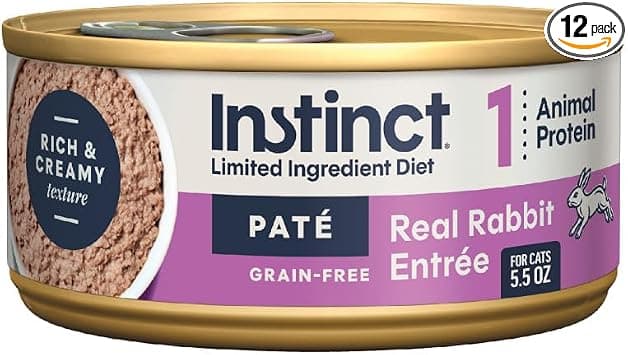
Instinct Limited Ingredient Diet Paté, Real Rabbit
One animal protein and one vegetable, which is what a limited ingredient diet is supposed to mean and often does not. Most cats do not need one, but a cat with chronic loose stool, itching or recurrent ear problems is a candidate for an elimination trial, and the protein has to be one the cat has not eaten before for the trial to prove anything. Rabbit qualifies in most households in a way that another chicken recipe does not, and the ingredient list is built without chicken, beef, fish, dairy, eggs, grain, potato, corn, wheat or soy. Run the trial with your vet, because a partially followed elimination diet tells you nothing.
We may earn a commission on this link. It never changes the ranking.
- Format
- Smooth pate
- Ingredients
- Rabbit, water, peas, pea protein, flaxseed, then minerals and vitamins
- Adequacy
- AAFCO Cat Food Nutrient Profiles, maintenance
- Guaranteed analysis
- 10% protein against 78% moisture, roughly 45% protein dry matter
- Sizes
- 3oz and 5.5oz cans; rabbit or turkey in the wet pate line
What works
- One animal protein and one vegetable, so the trial actually excludes what it claims to
- Rabbit is novel to most cats, which is the part that decides whether an elimination trial is informative
- Complete and balanced for maintenance, so it can be fed as the sole diet for the length of a trial
- No carrageenan, gums or other thickeners in the ingredient list
What to know
- No benefit for a cat without a suspected sensitivity
- An elimination trial needs veterinary supervision to be worth anything
- Around four dollars a can, the most expensive per can on this list
- Only rabbit and turkey in the wet pate line, so a cat that has eaten both leaves you nothing novel here
from $49.92 for 24 x 3oz
Price checked Jul 9, 2026
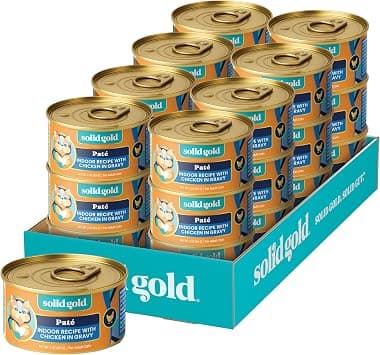
Solid Gold Flavorful Feast Chicken Paté
The value pick, and the one that makes a daily wet meal realistic in a multi-cat house. A conventional chicken pate at close to two dollars a can, complete and balanced, in the texture cats accept most readily. It is not the most interesting food here and it does not need to be. The cat that eats one of these every day is better off than the cat whose owner buys a premium can twice a month.
We may earn a commission on this link. It never changes the ranking.
- Format
- Smooth pate
- Size
- 3oz cans, 24 can case
- Texture
- Pate, the most widely accepted format
- Availability
- Widely stocked in pet specialty and online
What works
- Roughly two dollars a can, which is what makes daily wet feeding sustainable
- Pate texture has the highest general acceptance rate
- Complete and balanced rather than a supplemental topper
- Easy to find, which matters when a cat only eats one thing
What to know
- 3oz cans mean more cans per day for a full wet diet
- Less ingredient transparency than the premium options above
- Ordinary formulation, chosen for value rather than for anything distinctive
How they compare
| Food | Texture | Best for | Relative cost |
|---|---|---|---|
| Weruva Paw Lickin' Chicken | Shreds in gravy | Maximum moisture | High |
| Tiki Cat After Dark | Shreds in broth | Protein and organ meat | High |
| Open Farm Rustic Blend | Chunks | Traceable sourcing | High |
| Instinct LID Paté, Rabbit | Pate | Suspected food sensitivity | High |
| Solid Gold Flavorful Feast | Pate | Daily wet feeding on a budget | Low |
Who each one is wrong for
The gravy-heavy foods are wrong for a cat that needs calories. A can that is mostly broth delivers fewer kilocalories than its size implies, and an underweight or recovering cat needs density rather than dilution. Check the calorie content statement, not the can size.
The organ-rich and richer premium recipes are wrong for a cat being switched quickly. Most of the one-star reports on every food here, including the best of them, describe loose stool in the first week, and most of those describe an overnight switch. Ten to fourteen days, moving in quarters, resolves the majority of it.
The limited ingredient diet is wrong for a cat with no suspected sensitivity. It is a diagnostic tool, and using it as a general-purpose premium food means paying for a restriction that buys you nothing.
Every food here is wrong as the answer to a cat that has stopped using the litter box or is straining to urinate. That is a medical situation first, and once it has been excluded the next thing to look at is the litter and the box rather than the bowl. Diet has a role in managing urinary disease, and it is a role your vet assigns after a diagnosis, not one you choose off a shelf.
Switching without a hunger strike
Move over ten to fourteen days, mixing a little of the new food into the old and increasing the proportion every few days. Serve wet food at room temperature or slightly warmed, because aroma drives feline appetite far more than taste does and food straight from the fridge smells of almost nothing. Try more than one texture before concluding a cat dislikes a brand.
If the cat refuses outright, put the old food back rather than holding the line. Keeping a cat accustomed to more than one texture is worth doing on its own account, because the cat that has only ever eaten one dry food is very hard to move onto a therapeutic canned diet at eleven years old, which is exactly when that becomes necessary. Age is also where the labelling gets loosest, because there is no AAFCO senior life stage at all and the word on a 7+ bag commits the maker to nothing. Whatever split you land on, work in calories rather than portions, and check what the label is actually telling you before you commit to a case.
Questions people actually ask
How much wet food does an adult cat need per day?
Most adult cats need somewhere around 200 to 250 kcal daily, which is roughly one and a quarter 5.5oz cans of a typical pate, or more of a gravy-heavy food. Use the calorie content statement on the specific can rather than a general rule, and adjust by body condition.
Is it fine to feed wet and dry together?
Yes, and for most households it is the sensible pattern. Split the daily calorie target between the two rather than serving a full portion of each, which is the commonest way a mixed-feeding household ends up with an overweight cat.
Should I avoid carrageenan?
It is a preference rather than a safety finding. Carrageenan is a permitted thickener and the evidence for harm at pet food levels is thin. Several of the foods here omit it if you would rather not feed it, but it should not outrank the adequacy statement in your decision.
Can I leave wet food out during the day?
No more than a couple of hours at room temperature. That is the real constraint on wet feeding for households out all day, and a timed feeder with an ice pack is the usual workaround. Refrigerate opened cans and use them within a few days.
Is grain-free wet cat food better?
Not in general, and not for cats without a diagnosed sensitivity. Wet foods are naturally low in carbohydrate whether or not they carry the label. Judge a can on its adequacy statement, its protein on a dry matter basis and whether the cat finishes it.
Sources
- AAFCO: reading pet food labels
- AAFCO dog and cat food nutrient profiles
- Cornell Feline Health Center: feeding your cat
- Cornell Feline Health Center: feline lower urinary tract disease
- Merck Veterinary Manual: nutritional requirements of small animals
- WSAVA global nutrition guidelines
- Weruva Paw Lickin' Chicken
- Tiki Cat After Dark Chicken & Quail Egg
- Open Farm Harvest Chicken Rustic Blend
- Instinct Limited Ingredient Diet Patés, Real Rabbit
- Solid Gold Flavorful Feast Chicken Paté
As an Amazon Associate we earn from qualifying purchases. We earn a commission on some links, at no extra cost to you. It never changes which products we recommend or the order they appear in. Full disclosure

Who wrote this
Tess Lindqvist
Writer, cat products and everyday health
Tess Lindqvist writes the cat side of PetGearSearch, plus the health-adjacent categories where a label makes a claim the evidence has to back. The question asked of every product is the one owners actually ask at 3am: will the animal use it, and does it do the thing the box says.
The standard
How this guide was built
- The full product specification, ingredient panel or material spec, read end to end rather than summarised from a retail listing.
- The veterinary and regulatory guidance that applies to the category, cited by name and linked — AAFCO nutrient profiles, WSAVA manufacturer guidelines, the VOHC accepted-product list.
- Aggregated owner reviews at volume across retailers, read for the pattern rather than the anecdote, with deliberate attention to the one-star reports where the failure modes live.
- Every price checked against the live listing on the date printed beside it.