Best Kitten Food: Four Picks Read Off the Growth Profile
Four kitten foods judged against the AAFCO growth profile: the protein, calcium and DHA minimums that separate a real kitten food from an adult one.
By Tess Lindqvist, writer, cat products and everyday health
Published Sep 14, 2026 · 13 min read
- Cat Food
- 4 products compared
In this guide
The word "kitten" on the front of a bag is a marketing decision. The paragraph on the back is a regulatory one, and it is the only part of the package that has to be true. That paragraph is the AAFCO nutritional adequacy statement, and on a kitten food it has to name growth, or growth and reproduction, or all life stages. A bag that says adult maintenance is an adult food no matter how young the cat on the front looks.
That line settles most of this purchase. It does not settle which qualifying food to buy, because the growth profile is a floor rather than a recipe, and four foods can clear it and still behave completely differently in a bowl. Below is what the floor is, the half of the statement almost nobody reads, and four foods judged against it.
What the growth profile actually requires
AAFCO publishes two cat profiles: growth and reproduction, and adult maintenance. Both are stated on a dry matter basis, which strips the water out so a can and a bag can be compared honestly. The differences between them are specific and nameable.
Crude protein rises from 26.0 percent for an adult to 30.0 percent for growth. Calcium goes from 0.6 to 1.0 percent and phosphorus from 0.5 to 0.8, because a kitten is building skeleton rather than maintaining one. Vitamin A doubles, from 3332 to 6668 IU per kilogram. Iodine triples, copper in an extruded food goes from 5 to 15 milligrams per kilogram, and lysine climbs from 0.83 to 1.20 percent. The most interesting entry is EPA plus DHA: the growth profile sets a minimum of 0.012 percent, and the adult profile lists it as not determined. Those omega-3 fatty acids are a requirement for a growing kitten and not for a grown cat.
Then there is the one that surprises people. Taurine is identical in both profiles, at 0.10 percent for an extruded food and 0.20 percent for a canned one. A bag advertising added taurine for kittens is advertising a minimum every complete cat food already has to hit. Taurine matters enormously, which is exactly why AAFCO set the same floor for every life stage.
One footnote in the profile does real work. The figures presume an energy density of 4000 kcal per kilogram, and AAFCO states plainly that formulations of low energy density should not be considered adequate for growth based on comparison to the profiles alone. A thin, watery food can hit every percentage on the table and still not deliver enough calories into a stomach the size of a walnut. This is why how the protein figure on a label is calculated matters more on a kitten food than on anything else you will buy.
The half of the AAFCO statement nobody reads
The statement answers two separate questions. The first is the life stage. The second is how the manufacturer proved it, and there are exactly two routes.
A food can be formulated to meet the levels, which means the recipe was calculated against the profile or a laboratory analysis confirmed the finished food matches it. Or the claim can rest on animal feeding tests using AAFCO procedures, which means kittens were fed the actual food and monitored through a growth protocol. The second is slower and far more expensive, and relatively few brands do it.
Read the exact wording. Royal Canin's kitten gravy says it "is formulated to meet the nutritional levels established by the AAFCO Cat Food Nutrient Profiles for growth". Hill's kitten kibble says "animal feeding tests using AAFCO procedures substantiate that Hill's Science Diet Kitten Chicken Recipe Cat Food provides complete and balanced nutrition for growing kittens". Both are legitimate. Only one involved kittens eating the food.
This is also why WSAVA tells owners to stop reading the ingredient list first. Their guidance is blunt about it: the ingredient list "gives no information on the quality of the ingredients and can be very misleading on the overall quality of the food". The adequacy statement and the guaranteed analysis carry the information; the ingredient panel mostly carries the story.
The picks
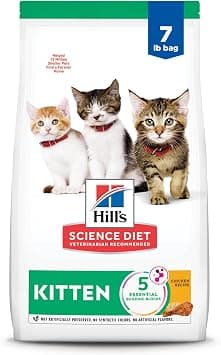
$34.97
Price checked Sep 14, 2026
Hill's Science Diet Kitten Chicken Recipe, 7 lb
Wrong for anyone shopping on price per pound, and wrong for anyone committed to grain-free, because brown rice, wheat gluten and barley sit in the first five ingredients. Right for everyone else: this is one of the few kitten foods whose adequacy claim rests on animal feeding tests rather than calculation, and at 38.5 percent protein and 23.1 percent fat on a dry matter basis it clears the growth floor with room to spare on both.
We may earn a commission on this link. It never changes the ranking.
- AAFCO claim
- Growth, by animal feeding tests
- Protein
- 38.5% dry matter
- Fat
- 23.1% dry matter
- Calcium / phosphorus
- 1.44% / 1.2% dry matter
- Energy
- 407 kcal per cup, 4067 kcal/kg
What works
- Adequacy claim substantiated by feeding trials, not formulation alone
- Fat at 23.1 percent dry matter gives the calorie density a growing kitten needs
- Calcium and phosphorus both published, which many brands will not do
What to know
- Costs roughly five dollars a pound against the budget pick
- Brown rice, wheat gluten and barley rule it out for a grain-free household
- Kibble only, so it does nothing for water intake
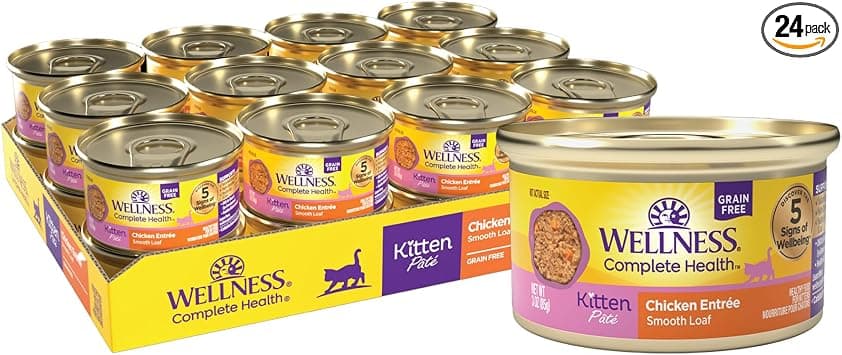
$36.08
Price checked Sep 14, 2026
Wellness Complete Health Pate Kitten, Chicken, 3 oz x 24
Wrong for a kitten that spits out smooth loaf textures, and wrong if you want one container that sits in a cupboard for a month. Right as the default canned food, because it is the most calorie-dense of the wet options here by a wide margin. Converted to dry matter it runs 50 percent protein and 27.3 percent fat, and its DHA minimum of 0.04 percent as fed works out near 0.18 percent dry matter, roughly fifteen times the 0.012 percent the growth profile asks for. Taurine lands around 0.45 percent dry matter against a 0.20 percent canned minimum.
We may earn a commission on this link. It never changes the ranking.
- AAFCO claim
- Growth
- Protein
- 11% as fed, about 50% dry matter
- Fat
- 6% as fed, about 27.3% dry matter
- DHA
- 0.04% as fed minimum
- Moisture
- 78% maximum
What works
- Highest energy density of the wet foods here, which is the point of a wet kitten food
- DHA runs far above the growth minimum rather than just clearing it
What to know
- Smooth pate is the texture some kittens reject outright
- Three-ounce cans mean opening several a day and refrigerating the rest
- Costs more per calorie than kibble, as every canned food does
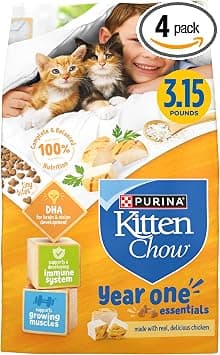
$22.56
Price checked Sep 14, 2026
Purina Kitten Chow Year One Essentials, 4 bags x 3.15 lb
Wrong for anyone who wants a feeding-trial claim or a low-carbohydrate food. Right when you are feeding more than one kitten, or feeding one on a budget, and the alternative is stretching an adult food. This listing ships four 3.15 lb bags, 12.6 lb for the price of one premium bag, and Purina's published analysis for its dry kitten food puts protein at a 40 percent minimum and fat at 13.5 percent. The bag carries the Year One Essentials name, so confirm the guaranteed analysis panel on what arrives.
We may earn a commission on this link. It never changes the ranking.
- Protein
- 40% minimum as fed
- Fat
- 13.5% minimum as fed
- Energy
- 414 kcal per cup
- Pack
- Four 3.15 lb bags, 12.6 lb total
- Cost
- Roughly $1.79 per pound
What works
- Under two dollars a pound, which is a third of the premium kibble here
- Protein minimum of 40 percent as fed is high for the price
What to know
- Adequacy claim rests on formulation, not feeding trials
- Fat at 13.5 percent is the lowest of the dry options, so portions run larger
- Product naming across this line has shifted, so read the panel on the bag
$54.96
Price checked Sep 14, 2026
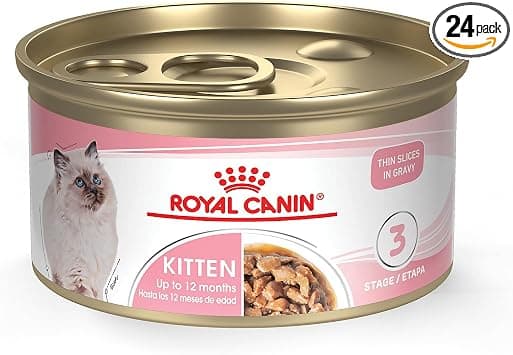
Royal Canin Feline Health Nutrition Kitten Thin Slices in Gravy, 3 oz x 24
Wrong as a primary diet and wrong for anyone counting calories per dollar: at 76 kcal a can and roughly $2.29 a can, this is the most expensive way to put energy into a kitten on this page. Right for one specific job, which is the kitten coming off milk that will not accept a loaf. The sliced-and-gravy texture is the one many of them take, and getting a reluctant kitten eating beats optimising the panel. Protein converts to about 53 percent dry matter, the highest here, but the fat is thin at about 12.6 percent.
We may earn a commission on this link. It never changes the ranking.
- AAFCO claim
- Growth, formulated to meet
- Protein
- 10.5% as fed, about 53% dry matter
- Fat
- 2.5% as fed, about 12.6% dry matter
- Energy
- 76 kcal per can, 893 kcal/kg
- Age range
- Kittens up to 12 months
What works
- Sliced texture in gravy is accepted by kittens that refuse smooth pate
- Highest dry matter protein of the four
What to know
- Lowest energy density here, so it takes many cans to meet a kitten's needs
- Roughly $2.29 a can is the highest cost per calorie on this page
- Water sufficient for processing leads the ingredient panel
| Food | Form | Protein (dry matter) | Fat (dry matter) | AAFCO claim | Price |
|---|---|---|---|---|---|
| Hill's Science Diet Kitten | Dry, 7 lb | 38.5% | 23.1% | Growth, feeding tests | $34.97 |
| Wellness Complete Health Kitten Pate | Wet, 24 x 3 oz | About 50% | About 27.3% | Growth | $36.08 |
| Purina Kitten Chow Year One Essentials | Dry, 4 x 3.15 lb | Not published | Not published | Growth | $22.56 |
| Royal Canin Kitten Thin Slices in Gravy | Wet, 24 x 3 oz | About 53% | About 12.6% | Growth, formulated | $54.96 |
| AAFCO growth minimum | Any | 30.0% | 9.0% | The floor | n/a |
How much, and how often
Cornell's Feline Health Center puts the schedule plainly: until they are six months old, kittens usually do best on three meals a day, and between six months and a year, twice daily feeding is generally best. Once the cat reaches about a year, once or twice a day is appropriate in most cases. The reason is mechanical rather than nutritional. Kittens need more food per pound of body weight than adult cats do, and a kitten's stomach cannot hold a day's calories in one sitting.
Portioning is where most people go wrong, in both directions. The feeding guide on a label is built for an average kitten, and yours is not average. Weigh weekly, expect steady gain, and adjust the amount rather than the food if the curve flattens or climbs too fast. Our guide on working out portions for a cat covers the arithmetic, and kittens use the same method against a higher calorie target.
On format, most households end up running both. Kibble is convenient and calorie-dense, canned food carries the water, and the case for moisture in a cat's diet starts young. Feeding both early also produces a cat that accepts both later, and Cornell makes the same point: variety prevents an exclusive preference for one food.
When the twelve months are up, do not change over in a single bowl. The transition that avoids a week of digestive upset takes about seven to ten days of blending, and the cat that has eaten several textures as a kitten is the one that goes through it without drama. Our wet food picks for adult cats are the natural next step from here.
The decision, in one paragraph
Buy the Hill's if you want the growth claim backed by kittens who actually ate it. Buy the Purina if you are feeding a litter or a budget, accepting a formulation claim and a leaner fat figure for a third of the price per pound. Add the Wellness pate as the wet half in either case, because its calorie density is the one that justifies a can. Keep the Royal Canin gravy in reserve for the kitten that will not eat a loaf.
Questions people actually ask
Can a kitten eat food labelled all life stages?
Yes. An all life stages claim means the food meets the AAFCO growth and reproduction profile, which is the stricter of the two, so it is legitimate for a kitten and a genuine way to save money in a multi-cat house. The trade-off is that a food built to satisfy both ends of the range is rarely optimised for either.
When does a kitten switch to adult food?
At around twelve months for most cats, and later for the large slow-maturing breeds such as Maine Coons, which are still filling out well past a year. The signal is growth finishing rather than a birthday. Switch over seven to ten days by blending, never in one bowl.
Does a kitten need a food with extra taurine?
No, in the sense that the AAFCO taurine minimum is identical for kittens and adult cats, at 0.10 percent dry matter for an extruded food and 0.20 percent for a canned one. Any complete cat food has to hit it. Added taurine on a kitten bag is a marketing line rather than a nutritional advantage.
Wet or dry for a kitten?
Both, if you can. Dry food delivers calories efficiently into a small stomach and can be left down, canned food carries water and tends to run higher in protein and fat on a dry matter basis. Feeding both early also builds a cat that accepts a texture change later.
Is grain-free better for a kitten?
There is no growth requirement a grain-free food meets that a grain-inclusive one cannot. Hill's kitten kibble includes brown rice and barley and rests its claim on feeding trials, while the Wellness pate is grain free and also meets growth. Choose on the adequacy statement and the guaranteed analysis.
How do I know a kitten food is not just an adult food in a smaller bag?
Read the nutritional adequacy statement on the back. It must name growth, growth and reproduction, or all life stages. If it says adult maintenance, the food is formulated to a 26 percent protein floor with half the calcium a growing kitten needs, whatever the front of the bag shows.
Sources
- AAFCO Dog and Cat Food Nutrient Profiles, growth and reproduction versus adult maintenance tables
- AAFCO: reading pet food labels
- AAFCO: selecting the right pet food
- FDA Center for Veterinary Medicine: "complete and balanced" pet food
- Cornell Feline Health Center: feeding your cat
- Cornell Feline Health Center: how often should you feed your cat
- WSAVA Global Nutrition Guidelines and owner toolkit
- Wellness Complete Health Kitten Pate Chicken: guaranteed analysis and ingredient panel
- Hill's Science Diet Kitten Chicken Recipe: guaranteed analysis and AAFCO statement
- Royal Canin Feline Health Nutrition Kitten Thin Slices in Gravy: guaranteed analysis and AAFCO statement
As an Amazon Associate we earn from qualifying purchases. We earn a commission on some links, at no extra cost to you. It never changes which products we recommend or the order they appear in. Full disclosure

Who wrote this
Tess Lindqvist
Writer, cat products and everyday health
Tess Lindqvist writes the cat side of PetGearSearch, plus the health-adjacent categories where a label makes a claim the evidence has to back. The question asked of every product is the one owners actually ask at 3am: will the animal use it, and does it do the thing the box says.
The standard
How this guide was built
- The full product specification, ingredient panel or material spec, read end to end rather than summarised from a retail listing.
- The veterinary and regulatory guidance that applies to the category, cited by name and linked — AAFCO nutrient profiles, WSAVA manufacturer guidelines, the VOHC accepted-product list.
- Aggregated owner reviews at volume across retailers, read for the pattern rather than the anecdote, with deliberate attention to the one-star reports where the failure modes live.
- Every price checked against the live listing on the date printed beside it.