Tug-of-War With a Dog: What the Play Studies Found About Letting It Win
Tug does not make a dog dominant or aggressive, and winning is fine. What the studies tie to trouble is who starts the game and how the human plays it.
By Tess Lindqvist, writer, cat products and everyday health
Published Oct 2, 2026 · 13 min read
- Toys & Play
In this guide
- Where the "never let it win" rule came from
- What the studies actually measured
- Winning is a reward, so use it as one
- The human's half of the game matters more than the dog's
- Tug as enrichment, and as a calming activity
- Picking the toy, and when to swap it
- When tug is the wrong game
- The short version
- Sources
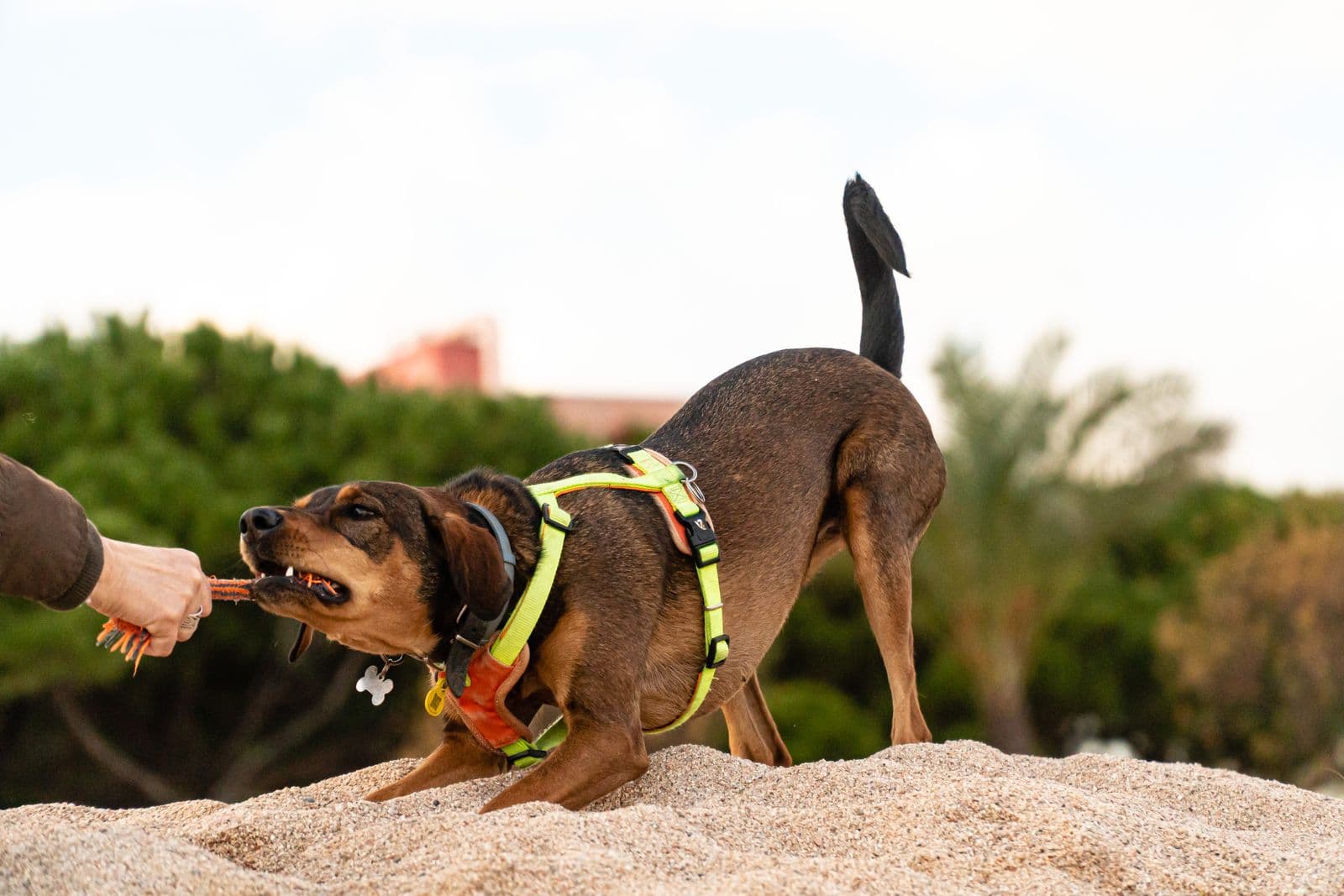
Most owners have heard the rule at some point: never play tug with a dog, and if you do, never let the dog win, or it will decide it outranks you. The rule is old, it is repeated confidently, and the research on dog play does not support it. Twenty-five years of studies point the other way. Tug is a game dogs play with people willingly and, for the most part, cooperatively, winning it does little to a dog's behaviour, and the details that do line up with problems are ones an owner controls: who starts the game, how it ends, and whether the person holding the other end is playing or disciplining.
Where the "never let it win" rule came from
The rule grew out of dominance theory, the idea that a dog misbehaves because it is trying to climb a household rank ladder, and that every contest over an object is a test of that rank. Under that model, a dog that wins tug has won a round of a status contest and will push for more.
The American Veterinary Society of Animal Behavior took that model apart in its position statement on dominance theory. It defines dominance narrowly, as a relationship between animals established by force or aggression and submission, which decides priority access to resources such as food, resting spots and mates. It then points out that most of the behaviour owners want to change, such as excessive barking, unruly greetings or failing to come when called, has nothing to do with priority access at all. Those behaviours persist because they have been rewarded by accident, and because nobody has trained a better alternative. The society recommends that training rest on reinforcing wanted behaviour and removing the reward for unwanted behaviour, and it warns that force-based approaches built on rank can make fear and aggression worse.
A game of tug sits squarely in that frame. The toy is a resource the dog wants, and the game is a way of handing it over on terms the owner sets.
What the studies actually measured
The owner survey. In 1998, Goodloe and Borchelt had the owners of 2,018 companion dogs rate how often their dogs showed each of 127 described behaviours, then ran a statistical analysis that sorted those behaviours into 22 underlying traits. Four of the traits related to aggression, which on its own showed that aggression in dogs is several separate things. The authors named the supposed link between tug-of-war games and aggression as one of the common beliefs their data challenged.
The filmed play sessions. Rooney and Bradshaw went further in 2003. They filmed 50 dog and owner partnerships during three-minute play sessions in which the owner picked the games, then put every pair through an hour-long test built to measure what is usually labelled "dominance" and "attachment". The analysis produced two dominance-related factors, which the authors called Amenability and Confident Interactivity, and four attachment factors, including one for separation-related behaviour.
Three findings matter for tug:
- Dogs that played tug and fetch scored high on Confident Interactivity.
- Winning or losing the games had no consistent effect on any of the test scores.
- Where the dog had started the majority of the games, the dog was significantly less amenable and more likely to show aggression.
The authors were careful about what that last line means. The study is correlational, and their reading was that the way a dog plays reflects its temperament and its relationship with its owner. The games did not appear to drive the dominance measures in any major way. A pushy dog that starts every game is probably pushy elsewhere too, and the game is where it shows.
The same study found that dogs whose owners played rough-and-tumble games, the body-contact wrestling kind, scored higher for amenability and lower for separation-related behaviour, and the authors suggested that contact-heavy play may affect attachment.
The review that pulled it together. In 2015 Bradshaw, Pullen and Rooney reviewed why adult dogs play at all, since domestic dogs are unusual among carnivores in playing routinely as adults. Their conclusion on competitive games was direct: most dogs do not appear to treat a competitive game with a human partner as a dominance contest, and winning possession of the toy appears to be simply rewarding. They also noted that dogs compete hard over objects when playing with other dogs, but are usually more cooperative when the partner is a person. Tug with a human is a different game from tug with another dog, even though it looks the same from the sofa.
Winning is a reward, so use it as one
If winning possession is rewarding, then letting the dog win is something an owner can hand out on purpose. A game the dog never wins is a game that never pays, and a dog that is allowed to take the toy now and then has a reason to bring it back for another round. That return trip is the part worth building.
The practical shape that fits the evidence:
You start the game, most of the time. The one pattern Rooney and Bradshaw tied to lower amenability was the dog initiating most games. Bringing the toy out yourself, at a time you choose, keeps the game as something you offer. A dog that drops a rope in your lap is asking politely, and saying yes some of the time is fine. Saying yes every time hands the dog the schedule.
A clear start and a clear stop. A word that means "take it" and a word that means "let go" turn tug into a sequence the dog can learn. When the dog lets go on cue, the reward is the game starting again, which is the reinforcement-first approach the AVSAB statement describes.
Teeth on skin ends the round. If teeth land on a hand or a sleeve, the game stops for a few seconds and the toy goes still. No scolding is needed. The pause carries the message because the dog wanted the game to continue.
Let it win regularly. Letting go and letting the dog parade the toy around is a payout. Ask for the toy back with the release cue, and restart.
End the session while it is still fun. Put the toy away while the dog still wants it.
The human's half of the game matters more than the dog's
A 2008 study from Eötvös Loránd University gives the clearest picture of why the owner's behaviour counts. Horváth, Dóka and Miklósi had working dogs play with their handlers for three minutes with a tug toy and measured how cortisol, a stress-linked hormone, changed in the dogs' saliva. They compared police dogs with border guard dogs.
The two groups went in opposite directions. Cortisol rose in the older police dogs and fell in the adult border guard dogs. When the researchers analysed the footage, the dogs' own behaviour barely differed between groups. The difference was in the people. The police officers spent the session mainly disciplining their dogs, while the border guards were genuinely playing, with affiliative and affectionate behaviour mixed in. The authors placed the result alongside other work showing that controlling, authoritative or aggressive behaviour from a partner raises cortisol, while play and affiliative behaviour lowers it.
The same toy and the same three minutes produced opposite stress responses depending on whether the human treated the game as play or as a compliance exercise. For a household dog, that argues for loose, cheerful tug with plenty of praise, and against tug used as a test of who is in charge.
Tug as enrichment, and as a calming activity
Tug also turns up as a deliberate enrichment activity. In a 2022 pilot study, Hunt, Whiteside and Prankel gave 10 assistance dogs in training, aged 12 to 14 months, each of seven enrichment activities twice in random order. The tug activity was 15 minutes of play with a known handler through tug and fetch games using soft toys and rope knots. Across all activities, relaxation behaviours rose and alert and stress behaviours fell. Stress-behaviour change scores after tug play were significantly lower than after a stuffed food toy, alongside play with another dog and a playhouse activity.
Ten dogs is a small sample, and the authors labelled it a pilot. It is still a useful signal that an assistance-dog programme, whose whole job is producing calm, reliable dogs, uses tug as a tool, and that in this pilot tug play lowered stress behaviour more than a food toy did.
Tug is also built into the Dog Mentality Assessment, the standardised temperament test developed by Svartberg and Forkman, whose play section scores a dog's interest in play, its grab on a thrown object, and tug-of-war. A 2023 study of Labrador Retrievers, comparing guide dogs with dogs withdrawn from training on temperament, used those same play scores as part of its excitability measure.
Picking the toy, and when to swap it
Tug toys take a load that ordinary chews do not, so material choice matters in two directions.
Soft enough for the mouth. A tug toy needs to give under the teeth. Hard nylon and other dense chews fail the thumbnail test for chew toys, and a dog bracing its jaw against a rigid object that a person is pulling on is the worst version of that problem. Rubber, fleece and firm rope are the usual materials for good reason.
Intact enough to swallow nothing. Rope toys are a tug classic, and a worn rope toy is also a ready source of loose strands a dog can swallow. Strands from rope and fabric toys are the subject of the guide to linear foreign bodies and toy risk, and the short version is that a fraying rope toy is a toy to retire. Tug toys belong in a drawer between sessions, which also stops an unsupervised dog from chewing one down to threads. For a dog that destroys everything in reach, the chew toys built for aggressive chewers are a better solo option, kept separate from the tug toy.
Swap the toy when the interest drops. Pullen, Merrill and Bradshaw's 2012 study of 16 Labrador retrievers measured how dogs lose interest in a toy. Each dog was offered the same toy in repeated 30-second periods until it stopped playing, and then a different toy. Interest came back with the new toy whether it differed in colour, in odour, or in both, and spacing the presentations anywhere from 10 seconds to 10 minutes apart made no difference to how fast the dog tired of the first one. In practice, a dog that has gone flat on a tug toy is usually bored of that toy, and a different one restarts the game. Two or three tug toys in rotation keep it fresh, the same principle that makes owners rotate puzzle feeders.
When tug is the wrong game
Tug is a good game for most dogs and a poor one for a few. Hold off and get help first if the dog:
- Guards toys, food or resting spots outside of play, stiffening or freezing when approached.
- Escalates during play to hard staring, a rigid body or growling that does not stop when the toy goes still.
- Will not release the toy even when the game stops, and gets more intense the longer the pause lasts.
None of those is a reason to label the dog dominant. The AVSAB statement is explicit that fear, anxiety, medical and genetic factors all drive behaviour that can look like a rank problem, and that a conflict involving aggression calls for a thorough medical and behavioural assessment to find the real cause.
The short version
Play tug. Let the dog win often enough that it stays interested. Start most of the games yourself, put a cue on letting go, pause the game for teeth on skin, and treat it as play with a partner. The evidence on winning and aggression has been in place since 1998, and what it points to is the person holding the other end.
Questions people actually ask
Does playing tug-of-war make a dog aggressive?
The studies say no. A survey of 2,018 dog owners challenged the link directly, and a filmed study of 50 dog and owner pairs found that playing tug went with confident, interactive dogs. The pattern that did line up with aggression was the dog starting most of the games, which reflects the dog's temperament more than the game.
Should I let my dog win at tug?
Yes, regularly. Winning or losing had no consistent effect on behaviour in the 2003 study, and a 2015 review concluded that winning possession of the toy is simply rewarding to most dogs. Letting the dog win keeps it interested and gives you a reward to hand out.
Can puppies play tug?
The same rules apply to a puppy as to an adult dog: soft toys, short sessions, a clear stop, and the game pausing if teeth land on skin. If a puppy's mouth or teeth look sore, or anything about its chewing concerns you, ask your vet before carrying on.
Is a rope toy safe for tug?
Firm rope is a classic tug material, used under supervision and put away between sessions. Once a rope toy starts shedding strands, retire it, because swallowed strands are a serious surgical risk.
My dog will not let go of the tug toy. What do I do?
Stop pulling and let the toy go still, then reward the release by starting the game again. Over time a release cue becomes the way the dog gets more tug. A dog that grows more intense when the game stops, or guards toys outside play, is worth discussing with a vet and a qualified behaviour professional.
Sources
- American Veterinary Society of Animal Behavior, "Position Statement on the Use of Dominance Theory in Behavior Modification of Animals"
- Goodloe, L.P. and Borchelt, P.L., "Companion dog temperament traits," Journal of Applied Animal Welfare Science, 1998, 1(4), 303-338
- Rooney, N.J. and Bradshaw, J.W., "Links between play and dominance and attachment dimensions of dog-human relationships," Journal of Applied Animal Welfare Science, 2003, 6(2), 67-94
- Bradshaw, J.W., Pullen, A.J. and Rooney, N.J., "Why do adult dogs 'play'?," Behavioural Processes, 2015, 110, 82-87
- Horváth, Z., Dóka, A. and Miklósi, A., "Affiliative and disciplinary behavior of human handlers during play with their dog affects cortisol concentrations in opposite directions," Hormones and Behavior, 2008, 54(1), 107-114
- Hunt, R.L., Whiteside, H. and Prankel, S., "Effects of Environmental Enrichment on Dog Behaviour: Pilot Study," Animals, 2022, 12(2), 141
- Pullen, A.J., Merrill, R.J. and Bradshaw, J.W., "Habituation and dishabituation during object play in kennel-housed dogs," Animal Cognition, 2012, 15(6), 1143-1150
- Bai, J. et al., "Association between TH/MAOB gene single nucleotide polymorphisms and excitability in Labrador Retrievers," Animal Genetics, 2023, 54(4), 570-575
As an Amazon Associate we earn from qualifying purchases. We earn a commission on some links, at no extra cost to you. It never changes which products we recommend or the order they appear in. Full disclosure

Who wrote this
Tess Lindqvist
Writer, cat products and everyday health
Tess Lindqvist writes the cat side of PetGearSearch, plus the health-adjacent categories where a label makes a claim the evidence has to back. The question asked of every product is the one owners actually ask at 3am: will the animal use it, and does it do the thing the box says.
The standard
How this guide was built
- The full product specification, ingredient panel or material spec, read end to end rather than summarised from a retail listing.
- The veterinary and regulatory guidance that applies to the category, cited by name and linked — AAFCO nutrient profiles, WSAVA manufacturer guidelines, the VOHC accepted-product list.
- Aggregated owner reviews at volume across retailers, read for the pattern rather than the anecdote, with deliberate attention to the one-star reports where the failure modes live.
- Every price checked against the live listing on the date printed beside it.