The Prey Sequence: How to Play With a Cat So It Works
Stalk, chase, pounce, kill, eat. A cat that loses interest after two minutes is usually playing a game that never resolves.
By Tess Lindqvist, writer, cat products and everyday health
Published Apr 19, 2026 · 9 min read
- Toys & Play
In this guide
Most owners who say their cat is not interested in toys are describing a real observation and drawing the wrong conclusion. The cat is interested. What is happening is that the game being offered does not resolve, and a cat that cannot complete the sequence disengages the way a person abandons a puzzle with a missing piece.
Feline predatory behaviour runs as a fixed order of stages: stalk, chase, pounce, kill bite, and eat. Each stage is triggered by the one before it. A laser dot supports the first three stages beautifully and cannot support the last two, which is why so many cats end a laser session looking agitated rather than satisfied. Understanding the sequence turns a two-minute session into a fifteen-minute one and changes a lot of behaviour that owners attribute to temperament.
The five stages, and what each one needs
Stalk. The cat freezes, lowers, and fixes on the target. This needs the prey to be partly hidden and to move away rather than toward. A toy dangled in a cat's face triggers nothing, because prey does not approach a predator. A toy that disappears behind a chair leg triggers everything.
Chase. Movement, and specifically movement in short bursts with pauses. Real prey does not run in a smooth line across a room, it darts and stops. A wand toy dragged steadily is boring. A wand toy that scuttles two feet, freezes, twitches, then scuttles again is irresistible.
Pounce. The cat commits. This is the stage that needs the toy to be catchable. A toy that is always yanked away at the last moment produces frustration rather than fun, and this is where most human play technique fails, because the human instinct is to keep the toy out of reach.
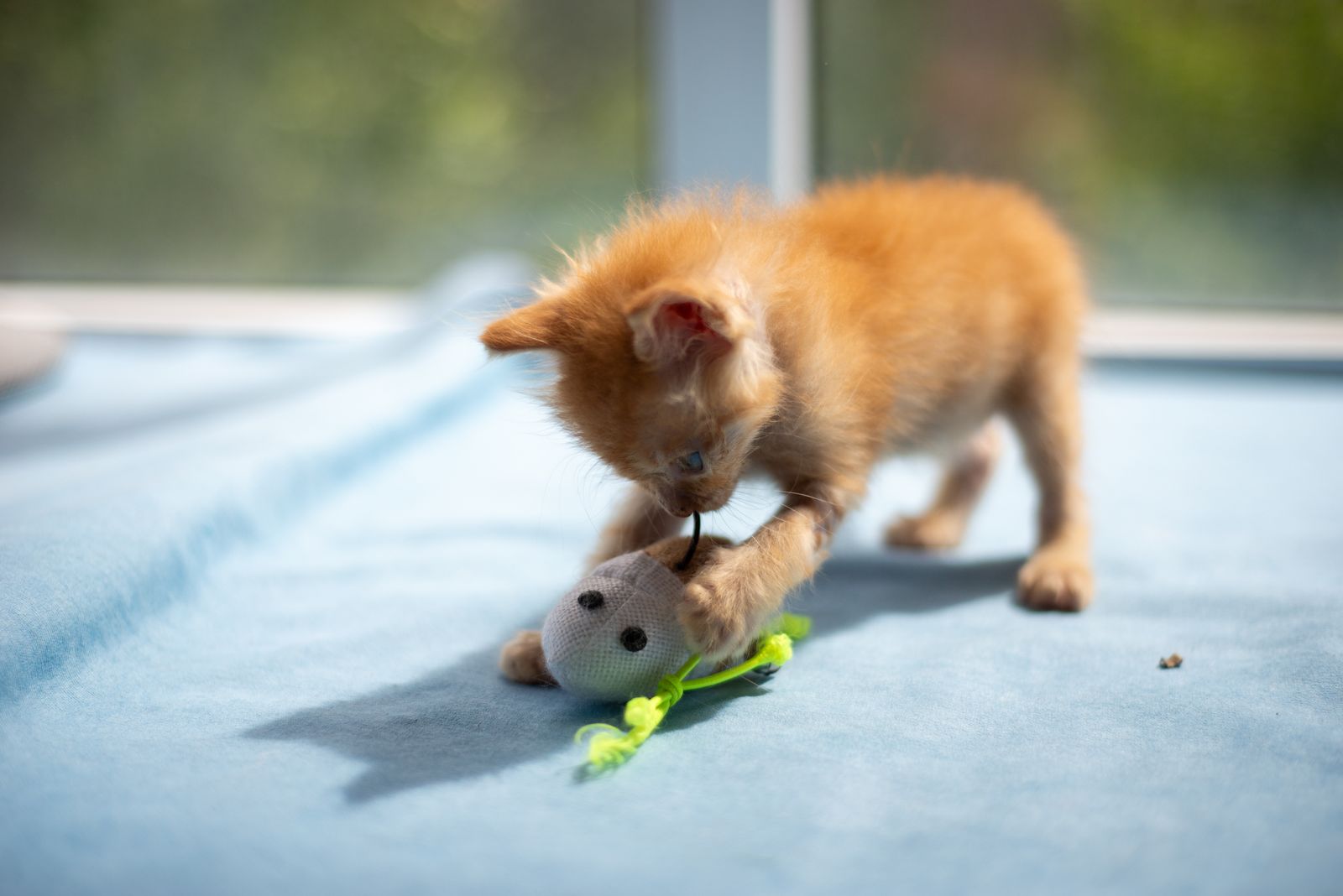
Kill bite. The cat grabs, bites and often bunny-kicks with the hind legs. It needs a toy of the right size and texture, roughly mouse-sized, that it can hold. A dot of light cannot be held.
Eat. The resolution. In the wild this is the reward that closes the loop, and in the house it is supplied by a treat or a meal immediately after the catch. This stage is the one owners skip and it is the one that makes the whole sequence land.
The session, in practice
Fifteen minutes, twice a day, is a reasonable target for a healthy adult indoor cat, and two sessions of ten will do. What matters more than the total is the shape.
Use a wand toy so the prey is at the far end of a string rather than attached to your hand. A cat that plays with hands learns that hands are prey, and un-teaching that in an adult cat is much harder than never teaching it.
Move the toy away from the cat and along the ground, not toward the cat and not through the air. Ground-level scuttling is what most cats respond to hardest, because most feline prey lives on the ground. Birds are a real category too and vertical flapping suits some cats, but if a cat is unresponsive, try the floor first.
Use cover. Drag the toy behind a sofa, under a rug edge, around a door frame. Partial concealment is the strongest single trigger for the stalk, and an open floor with nowhere to hide gives the cat nothing to work with.
Pause. Frequently, and for longer than feels natural. A frozen toy with an occasional twitch pulls a cat forward far more reliably than a toy in constant motion, because a predator waits for the moment.
Let the cat catch it. Several times through the session, not once at the end. Each successful catch resets the arousal and the cat re-engages. Never letting the cat catch it produces a cat that stops trying, which is the behaviour people describe as losing interest.
Wind down rather than stopping dead. Slow the toy, let the last catch be a long one, and then feed. A meal or a few treats immediately after the final catch completes the sequence, and it also explains why cats sleep so heavily after a good session.
Why this matters beyond entertainment
Indoor cats have a hunting drive with nowhere to go. In an outdoor cat the sequence runs several times a day on its own. In an indoor cat it does not run at all unless someone runs it, and unresolved predatory motivation is behind a lot of what gets called behaviour problems: the ankle ambush, the 3am zoomies, the cat that plays too roughly.
Play is the standard intervention for inter-cat tension alongside adding resources. Separate play sessions with each cat, at the same time of day, give each animal a way to discharge arousal that does not involve the other one.
It is the cheapest weight management tool available. Feline obesity is common and indoor cats are the population most affected. Two fifteen-minute sessions a day is real activity, and it costs nothing.
It is a health monitor. A cat that has stopped playing has told you something. Reduced play, reduced jumping and reduced grooming are the classic under-recognised signs of feline arthritis, which is common in older cats and diagnosed in very few, because cats do not limp in ways owners notice.
The laser pointer question
Laser pointers are not banned and they are not ideal, and both halves of that matter.
The problem is structural. A laser supports stalk, chase and pounce, then offers nothing to bite and nothing to eat. Some cats handle that fine. Others become visibly frustrated, and in a minority the frustration generalises into compulsive light-chasing behaviour that outlasts the toy.
The fix is simple and costs nothing: finish every laser session by landing the dot on a physical toy or a scattered treat, and let the cat catch that. The sequence completes, the loop closes, and the tool becomes useful again. Never shine it in eyes, feline or human.
Choosing toys, briefly
Rotate them. Cats habituate fast, and six toys rotated weekly outperform twenty toys left permanently on the floor. Keep the wand toys put away between sessions, both because it preserves novelty and because unsupervised string is a hazard.
Prefer toys around the size of a cat's natural prey, roughly mouse to small-bird sized. Very large plush toys are for bunny-kicking rather than for the sequence, which is a legitimate but different game.
Solo toys matter too, for the hours you are not there. Puzzle feeders, in particular, engage the last two stages of the sequence directly by making the cat work for food, and the evidence on whether they earn their place is better than most enrichment claims. Vertical space is the other half of an indoor cat's environment, and where you put a cat tree decides whether it gets used at all.
If a cat still will not play
Rule out pain first, particularly in a cat that used to play and stopped. That is a change in behaviour, and changes in behaviour in cats are clinical information.
Then vary the prey type. Cats develop individual preferences, and a cat uninterested in a feather wand may go straight for something that moves like a mouse, or a snake-like ribbon dragged along the skirting. Try ground, air and under-cover movement separately before concluding anything.
Try the hour before a meal. A slightly hungry cat hunts. A cat that has just eaten does not, and most people play with their cats after dinner, which is exactly the wrong time.
And try shorter. Some cats give you three minutes of intense engagement and are done, and three good minutes four times a day is a better outcome than fifteen minutes of a cat being pestered. The toys worth owning are the ones that fit how your particular cat hunts, which is a question you answer by watching rather than by reading the packaging.
Questions people actually ask
How long should I play with my cat each day?
Two sessions of ten to fifteen minutes is a reasonable target for a healthy adult indoor cat. Session quality matters more than total time: a shaped session that lets the cat catch the toy several times and ends with food beats twice as long spent waving something.
Are laser pointers bad for cats?
They are incomplete rather than bad. A laser supports the chase and not the catch, and some cats find that genuinely frustrating. Finish every laser session by landing the dot on a physical toy or a scattered treat so the sequence can resolve.
Why does my cat bite me during play?
Usually because hands have been used as toys at some point, or because arousal built with no outlet. Use a wand toy so the target is at the end of a string, let the cat catch it regularly to discharge arousal, and end sessions with food rather than stopping abruptly.
My cat only plays for two minutes. Is that normal?
It can be, and it can also mean the game never resolves. Try letting the cat catch the toy earlier and more often, add cover to hide behind, and play before a meal rather than after. If a cat that used to play has stopped, see a vet.
What time of day should I play with my cat?
Cats are most active at dawn and dusk, and a session before a meal works with the hunt-then-eat sequence rather than against it. A late-evening session followed by food is also the standard fix for a cat that wakes the household at 3am.
Sources
As an Amazon Associate we earn from qualifying purchases. We earn a commission on some links, at no extra cost to you. It never changes which products we recommend or the order they appear in. Full disclosure

Who wrote this
Tess Lindqvist
Writer, cat products and everyday health
Tess Lindqvist writes the cat side of PetGearSearch, plus the health-adjacent categories where a label makes a claim the evidence has to back. The question asked of every product is the one owners actually ask at 3am: will the animal use it, and does it do the thing the box says.
The standard
How this guide was built
- The full product specification, ingredient panel or material spec, read end to end rather than summarised from a retail listing.
- The veterinary and regulatory guidance that applies to the category, cited by name and linked — AAFCO nutrient profiles, WSAVA manufacturer guidelines, the VOHC accepted-product list.
- Aggregated owner reviews at volume across retailers, read for the pattern rather than the anecdote, with deliberate attention to the one-star reports where the failure modes live.
- Every price checked against the live listing on the date printed beside it.