Dog Chew Toys and the Thumbnail Test
One rule prevents most fractured teeth: if a thumbnail cannot dent it, it is hard enough to break the upper carnassial. Here is the rest of the list.
By Tess Lindqvist, writer, cat products and everyday health
Published May 26, 2026 · 8 min read
- Toys & Play
In this guide
Chewing is a normal, necessary canine behaviour and the products sold to satisfy it include several of the most common causes of dental fracture that veterinary dentists see. Those two facts sit awkwardly together, and the aisle does nothing to separate them, because hardness is marketed as durability and durability sells.
There is one test that resolves most of it, and it takes two seconds in the shop.
The thumbnail test
Press your thumbnail into the surface of the chew. If it leaves a mark, the material has some give and will yield before a tooth does. If your thumbnail slides off without denting it, the chew is harder than tooth enamel and the tooth is what will break.
The related check is the knee test: if you would not want it dropped on your kneecap, it is too hard to be in a dog's mouth.
By that standard, the following are all too hard for most dogs: antlers, natural bones of any kind including weight-bearing beef bones, hooves, hard nylon bones, and rocks, which some dogs will genuinely try. Ice cubes are also harder than people assume.
What actually breaks
The tooth that fractures is almost always the upper fourth premolar, the carnassial, which is the large shearing tooth on each side of the upper jaw. It carries the highest bite force and it is the one a dog uses to crack something hard.
The typical injury is a slab fracture: a vertical section of the outer surface shears away, exposing dentine and sometimes the pulp. It is painful, and it usually does not look like anything from outside, because dogs continue eating and playing with fractured teeth. Owners find out at a dental appointment.
The treatment is extraction or a root canal, both under general anaesthesia, and neither is cheap. This is the single most avoidable dental injury in dogs, and the thumbnail test avoids nearly all of it.
The other three failure modes
Hardness is one risk. There are three more, and different products fail in different ways.
Ingestion and obstruction. Anything a dog can bite a piece off and swallow can obstruct. This is the risk with rawhide, with squeaky toys once the seam goes, with rope toys that shed strands, and with the last small piece of any chew. The rule that prevents most of it is to take the end away: most chew emergencies are the final third that a dog decided to swallow whole rather than keep working on.
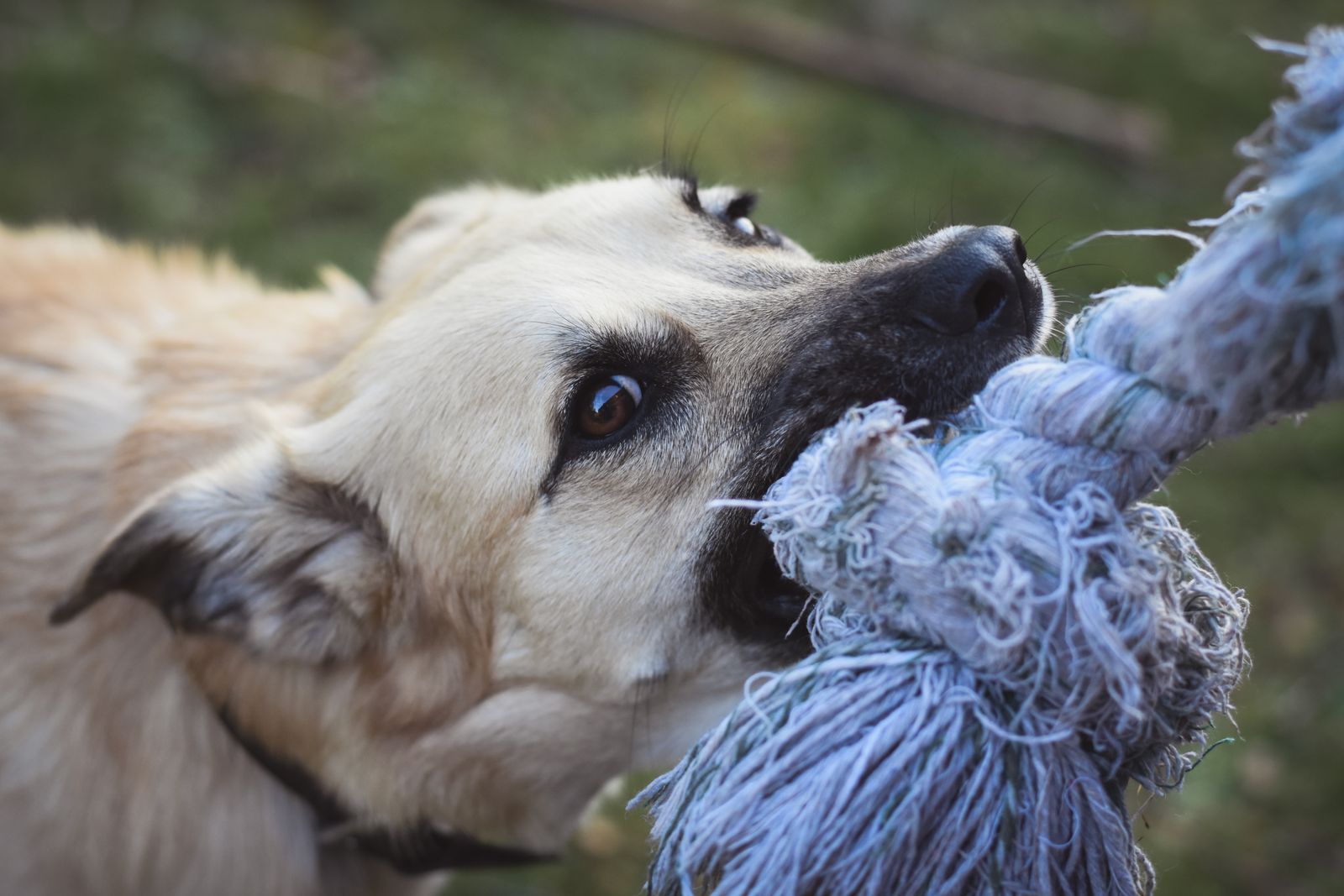
Linear foreign bodies. Rope and fabric strands are a specific and worse category, because a length of ingested string or fabric can gather the intestine along it. That is a surgical emergency rather than a wait-and-see. Rope toys are fine for tug and fine under supervision, and they are not a chew-it-alone toy for a dog that strips fibres.
Tug itself is a sound game with an intact toy, and letting the dog win is fine: the evidence is in what the play studies found about tug-of-war.
Choking on the wrong size. A ball small enough to pass behind the tongue can lodge in the airway, and this has killed dogs. Tennis balls are the classic case in large breeds. Size up: a toy should be too big to fit fully in the mouth. Tennis balls carry a second problem too, in that the fuzz is mildly abrasive and heavy long-term tennis ball chewing wears the tooth crowns down.
What to buy instead
Firm rubber that flexes. The category that passes the thumbnail test and still survives a determined dog. Natural or synthetic rubber that gives under a thumbnail but returns to shape absorbs bite force rather than resisting it. Stuffable versions extend the working life of a chew session enormously, and freezing a stuffed one turns twenty minutes into an hour.
Softer edible chews, sized correctly. Fine for many dogs, with two provisos: they are food, so the calories count, and the last piece needs taking away. A large dental chew can run 70 to 120 kcal, which is a serious fraction of a small dog's daily allowance and a common reason a dog on a measured diet still gains weight. Subtract them from meals rather than adding them, which is arithmetic most households skip.
VOHC-accepted dental chews, if the reason you are buying is teeth rather than occupation. That list is the only claim in oral care with a published threshold behind it, and it is worth reading before you pay for a plaque claim.
Puzzle and food-dispensing toys. For a dog chewing out of boredom, which is most destructive chewing in adult dogs, the answer is occupation rather than a harder toy. Whether puzzle feeders earn their place is a question with a better evidence base than most enrichment claims.
Matching the toy to the dog
Puppies chew because they are teething and because everything is new. They need soft, safe, size-appropriate things and a lot of redirection. Hard chews are wrong for a puppy in a specific way, because deciduous teeth and erupting adult teeth are both more vulnerable than a mature tooth.
Power chewers, the dogs that destroy everything in ten minutes, are the ones owners buy antlers for, and they are exactly the population that fractures teeth. The correct answer is a very tough rubber toy, sized up, plus supervision, plus accepting that consumables get consumed. Escalating hardness is escalating risk.
Gentle chewers can use a wider range, including plush, and still need the seam checked. A plush toy is finished the moment the stuffing is accessible.
Senior dogs often have worn or already-damaged teeth and existing periodontal disease. Soft chews only, and a dental check first.
Supervision, inspection and the bin
Three habits do more than any purchase.
Supervise chewing, particularly with anything new and anything edible. Most emergencies happen in the ten minutes nobody was watching.
Inspect toys weekly. Look for splits, exposed stuffing, loose squeakers, frayed rope ends, and chunks missing. A toy with a hole in it is a toy that is being eaten.
Throw things away earlier than feels wasteful. A chew worn down to a swallowable size is no longer a chew, and the cost of replacing it is trivially small against the cost of an obstruction surgery.
The rule, restated
Press a thumbnail into it. If it does not dent, put it back. Size it so it cannot fit entirely in the mouth. Supervise, inspect weekly, and bin it early. Count edible chews as food.
That is the whole checklist, and it prevents almost every chew-related injury a general practice sees. The dogs that break teeth are not unlucky, they are the dogs that were given something harder than a tooth because it was sold as lasting longer.
Questions people actually ask
Are antlers safe for dogs?
They are one of the commonest causes of fractured teeth. Antlers fail the thumbnail test comfortably, and the tooth that usually breaks is the upper fourth premolar, which then needs extraction or a root canal under anaesthesia.
What about raw bones?
Raw bones are softer than cooked ones and still hard enough to fracture teeth, and they carry a bacterial handling risk for the household. Cooked bones are worse again because they splinter. Neither passes the thumbnail test.
Is rawhide dangerous?
The main risks are obstruction from a swallowed piece and contamination, rather than tooth fracture. If you use it, supervise closely, size it generously, and take the last third away. Firm rubber alternatives avoid the question.
My dog destroys everything. What can I give it?
A very tough flexible rubber toy, sized up, ideally stuffable so the chew session has a purpose beyond destruction. Escalating to harder materials is what fractures teeth. Accept that consumables get consumed and budget for replacement.
Are tennis balls bad for dogs?
Two problems. A ball small enough to pass behind the tongue can lodge in the airway, which has killed dogs, so size up for large breeds. And the fuzz is abrasive, so heavy long-term chewing wears the tooth crowns. Occasional fetch is a different matter from all-day chewing.
Sources
As an Amazon Associate we earn from qualifying purchases. We earn a commission on some links, at no extra cost to you. It never changes which products we recommend or the order they appear in. Full disclosure

Who wrote this
Tess Lindqvist
Writer, cat products and everyday health
Tess Lindqvist writes the cat side of PetGearSearch, plus the health-adjacent categories where a label makes a claim the evidence has to back. The question asked of every product is the one owners actually ask at 3am: will the animal use it, and does it do the thing the box says.
The standard
How this guide was built
- The full product specification, ingredient panel or material spec, read end to end rather than summarised from a retail listing.
- The veterinary and regulatory guidance that applies to the category, cited by name and linked — AAFCO nutrient profiles, WSAVA manufacturer guidelines, the VOHC accepted-product list.
- Aggregated owner reviews at volume across retailers, read for the pattern rather than the anecdote, with deliberate attention to the one-star reports where the failure modes live.
- Every price checked against the live listing on the date printed beside it.