Best Toothpaste for Dogs and Cats, Read Against the VOHC List
Only a handful of pet toothpastes carry the VOHC seal, and every one of them was accepted on the dogs list. Three worth buying, and who each is wrong for.
By Tess Lindqvist, writer, cat products and everyday health
Published Oct 8, 2026 · 13 min read
- Supplements & Health
- 3 products compared
In this guide
Brushing is the benchmark of home dental care, and the Veterinary Oral Health Council writes it into its own trial rules: when a manufacturer tests a brush or similar device, the positive control group gets daily brushing with an ADA-accepted, flat-profile, soft-bristle manual toothbrush.
So the toothpaste aisle ought to be the easiest one in pet oral care to shop. It is not. Nearly every tube makes a plaque or tartar claim, the council's August 2026 lists name only a few toothpastes, and every standalone tube among them sits on the dogs list, even though the two sold on Amazon are labelled for cats as well. How the VOHC threshold works, and what the seal does and does not prove, is the background to read first. This guide picks up from there and narrows a crowded shelf to three tubes.
What the brush does and what the paste adds
The 2019 AAHA Dental Care Guidelines for Dogs and Cats are blunt on three points that decide how much to spend on paste. Brushing removes plaque, not calculus. It has to be done daily to be of benefit. And even daily brushing does not remove the need for anesthetised oral exams, dental radiographs and treatment, exactly as in human dentistry.
The frequency point has a controlled trial behind it. Harvey, Serfilippi and Barnvos brushed beagles daily, every other day, weekly or every other week for 28 days and compared them with an unbrushed control group. Brushing more often did more to slow plaque and calculus and to reduce existing gingivitis, and daily or every-other-day brushing was significantly better than weekly or fortnightly. Their recommendation was daily brushing.
That puts the paste in its place. The bristles do the mechanical work. A paste earns its money in three ways: a flavour the animal accepts, so the brushing actually happens, a formula that is safe to swallow, since no dog or cat will spit, and, in the best case, an active ingredient that adds a measured effect on top of the brush. Only the last of those is what a VOHC seal on a toothpaste certifies.
The rule that comes before any brand
Never use human toothpaste. The FDA lists toothpaste among the household products that can contain xylitol, which is dangerous to dogs, and says plainly to use pet toothpaste for pets and never a human one. Cornell's Feline Health Center says the same for cats: use only a gel or paste designed for cats, because human products can be toxic to them. Every tube below is formulated to be swallowed.
What the VOHC lists actually say about toothpaste
The dogs list groups toothpastes with water additives, gels and sprays. In the August 2026 edition the toothpaste entries are Petsmile Professional Pet Toothpaste (plaque, awarded 2011), Tartar Shield PRO CARE Natural Pet Toothpaste (tartar, 2025), Dentalis Canine Toothpaste (plaque, 2026) and a Dentalis toothpaste and dental stick combination. HealthyMouth's toothpaste and brush kit for medium and large dogs appears under toothbrushes, and so does the generic ADA-compliant soft-bristle flat-head toothbrush, accepted for both plaque and tartar.
That last entry is the most useful line on the page. The plain brush holds both claims. The best of the pastes holds one.
The cats list is shorter still. Its only toothpaste entry is the HealthyMouth toothpaste and brush kit for cats, accepted for plaque in 2015. No standalone cat toothpaste carries the seal, and the two VOHC-accepted tubes below are both "dogs and cats" on the label with an acceptance that names dogs. For a cat, the honest framing is that any safe, palatable feline-suitable paste plus a soft brush is doing the work, and the seal is not the deciding factor.
Neither Dentalis nor the HealthyMouth kits turned up as an Amazon listing this site could verify. The three below are the ones that cleared a live listing check today at a price matching the brand's own.
The three worth buying
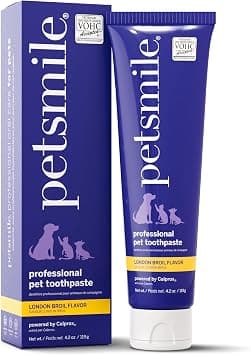
$25.00
Price checked Oct 8, 2026
Petsmile Professional Pet Toothpaste, London Broil, 4.2 oz, dogs and cats
The tube to buy for a dog if the seal is the deciding factor. Petsmile has held VOHC acceptance for plaque since 2011, the oldest toothpaste entry on the dogs list and the claim that matters more for gum health. The active ingredient is calcium peroxide, which Petsmile sells as Calprox, with dicalcium phosphate as the mild abrasive and urea peroxide alongside. At $25.00 for 4.2 oz it works out to about $5.95 an ounce, and the Amazon price matches Petsmile's own store to the cent. Two things on the box overreach. The marketing calls it the only VOHC-accepted toothpaste, which stopped being true when Tartar Shield was accepted in 2025 and Dentalis in 2026. And the no-brush positioning sits awkwardly with Petsmile's own advice to brush daily for best results, which is the advice to follow.
We may earn a commission on this link. It never changes the ranking.
- Size
- 4.2 oz tube, London Broil flavour
- VOHC claim
- Plaque, dogs list, 2011
- Active
- Calcium peroxide (Calprox)
- Abrasive
- Dicalcium phosphate dihydrate
- Cost per ounce
- About $5.95
- Labelled for
- Dogs and cats
What works
- Longest-standing VOHC plaque acceptance of any toothpaste on the dogs list
- Plaque is the claim tied to gum inflammation, not just visible tartar
- Amazon price matches the brand's own store
- London Broil, Rotisserie Chicken and cheese flavours give a fussy dog options
What to know
- The seal is on the dogs list only, so a cat buyer gets no VOHC evidence for the cat
- Dearer per ounce than the enzymatic option
- Marketing still claims it is the only accepted toothpaste, which is out of date
- No-brush framing invites owners to skip the part that does most of the work
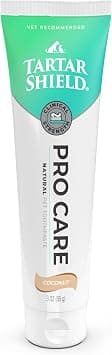
$20.99
Price checked Oct 8, 2026
Tartar Shield PRO CARE Dog and Cat Toothpaste, Coconut, 3 oz
The newer VOHC tube, and the one to pick when tartar rather than gum inflammation is the visible problem. Tartar Shield's own page is precise about the scope: VOHC accepted for tartar control in dogs. The panel is short and readable, built on coconut oil, kaolin clay as a gentle abrasive, zinc citrate, malic acid and miswak stem extract, with no sweeteners or animal by-products. The brand's directions are the right ones for a reluctant animal: start with paste on a finger, move to a soft-bristle brush once the dog is comfortable, no rinsing, every day. At $20.99 for 3 oz it is the dearest per ounce here at about $7.00, and the Amazon price matches the brand's store.
We may earn a commission on this link. It never changes the ranking.
- Size
- 3 oz tube, coconut flavour
- VOHC claim
- Tartar, dogs list, 2025
- Key ingredients
- Coconut oil, kaolin, zinc citrate, malic acid, miswak
- Free from
- Sweeteners, dyes, sulfates, parabens, animal by-products
- Cost per ounce
- About $7.00
- Labelled for
- Dogs and cats
What works
- Current VOHC acceptance, awarded in 2025
- Short ingredient panel with no sweeteners of any kind
- Brand directions build the habit from finger to brush, which suits a nervous dog
- Amazon price matches the brand's own store
What to know
- Acceptance covers tartar only, the weaker of the two claims for gum health
- Seal is on the dogs list, so it proves nothing about cats
- Dearest per ounce of the three at about $7.00
- Single flavour, so there is no fallback if the dog refuses coconut
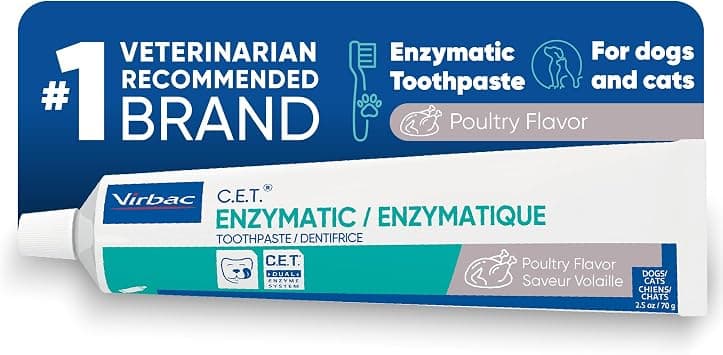
$12.29
Price checked Oct 8, 2026
Virbac C.E.T. Enzymatic Toothpaste, Poultry, 2.5 oz (70 g), dogs and cats
The pick for cats and for budgets, with one plain caveat: C.E.T. Enzymatic Toothpaste does not appear on either VOHC list as a toothpaste. Virbac's own seal-holding products are chews and a water additive, not this paste. What it does offer is the thing that makes brushing happen. Virbac sells it in five flavours (poultry, malt, vanilla-mint, beef and seafood), formulates it without foaming agents, and states it is safe for pets to swallow, which matters more for a cat than for any dog. The dual-enzyme system is Virbac's description of how it works, not a VOHC finding. At $12.29 for the 70 g tube it is about $4.90 an ounce, inside the $11.30 to $14.99 range other retailers charge.
We may earn a commission on this link. It never changes the ranking.
- Size
- 2.5 oz (70 g) tube, poultry flavour
- VOHC claim
- None as a toothpaste
- Formula
- Dual-enzyme system, no foaming agents
- Flavours
- Poultry, malt, vanilla-mint, beef, seafood
- Cost per ounce
- About $4.90
- Labelled for
- Dogs and cats
What works
- Cheapest per ounce of the three at about $4.90
- Five flavours, including poultry and seafood for cats
- No foaming agents, made to be swallowed
- Price sits inside the normal range across other retailers
What to know
- No VOHC acceptance as a toothpaste, so the enzyme claim is the maker's own
- Smallest tube of the three at 70 g
- Easy to mistake for the seal-holding C.E.T. chews and water additive
How they compare
| Toothpaste | VOHC claim | Tube | Price | Per ounce |
|---|---|---|---|---|
| Petsmile Professional, London Broil | Plaque, dogs list | 4.2 oz | $25.00 | About $5.95 |
| Tartar Shield PRO CARE, coconut | Tartar, dogs list | 3 oz | $20.99 | About $7.00 |
| Virbac C.E.T. Enzymatic, poultry | None | 2.5 oz (70 g) | $12.29 | About $4.90 |
The per-ounce gap matters less than the claim column, and less again than whether the animal accepts the taste every day.
Who each one is wrong for
Petsmile is wrong for a buyer who picked it for a cat on the strength of the seal. The acceptance sits on the dogs list. It may suit a cat perfectly well, but nothing on the VOHC cats list says so, and a cat owner paying the premium for the logo is paying for evidence gathered in dogs.
Tartar Shield is wrong for a dog whose problem is red, inflamed gums. Its acceptance covers calculus. Plaque is the soft film at the gum margin that drives inflammation, which is why the plaque claim is the more useful of the two. A dog with gingivitis needs a vet first, and then a plaque-claim paste rather than a tartar-claim one.
C.E.T. Enzymatic is wrong for anyone who wants a council-backed result in the tube. It is a swallow-safe paste in five flavours with no VOHC acceptance as a toothpaste. Buy it for palatability and price, and let the brush carry the evidence.
All three are wrong for a mouth that already hurts. AAHA notes that brushing already inflamed gums causes pain and teaches the animal to resist. Cornell says the same for cats with severe gingivitis and advises talking to a vet before starting. Fix the mouth first, then build the habit.
Making brushing stick
The paste only matters if the brush goes in daily, and that is a training problem more than a product one. Cornell's Feline Health Center sets out a four-week programme for cats. In the first week, let the animal sniff and lick a dab of paste from a finger, with a reward. In the second, put a dab on one canine tooth each day. By the third, the paste goes on the brush and the animal licks it off. Only in the fourth does the brush go between lip and gum, angled at 45 degrees towards the gumline, working the outside surfaces. Cornell notes a cat's tongue keeps the inside surfaces reasonably clean, so the outsides are the job.
The same slow approach that makes trimming a cat's nails bearable applies here: stop each session before the animal objects, so the routine always ends well. Dog owners who have used the touch, treat, release method for trimming dog nails already know the pattern.
For the brush itself, the VOHC dogs list accepts any ADA-compliant soft-bristle flat-head toothbrush for plaque and tartar. That is a description, not a brand, so the bristle and head shape are what to check on the packet. Pair the brush with paste, and if a chew is added on top, pick one from the accepted dog chews, costed per day and per calorie.
What toothpaste cannot do
Cornell puts dental disease at 50 to 90 percent of cats older than four. AAHA is clear that no home routine replaces the anesthetised exam, radiographs and cleaning, because the disease that matters most sits below the gumline where no brush reaches. Bad breath, dropping food, chewing on one side, pawing at the mouth or a reluctance to have the face touched are reasons to book an appointment, not to change paste.
Questions people actually ask
Is there a VOHC-accepted toothpaste for cats?
Not as a standalone tube. The August 2026 cats list has one toothpaste entry, the HealthyMouth toothpaste and brush kit for cats, accepted for plaque. Petsmile and Tartar Shield are labelled for dogs and cats, but their acceptance appears on the dogs list.
Can I use human toothpaste on my dog or cat?
No. The FDA lists toothpaste among products that can contain xylitol, which is dangerous to dogs, and tells owners to use only pet toothpaste on pets. Cornell's Feline Health Center says human products can be toxic to cats.
How often should I brush my pet's teeth?
Daily. AAHA states brushing has to be daily to be of benefit, and a controlled beagle trial found daily or every-other-day brushing significantly better than weekly or fortnightly brushing.
Does the toothpaste or the toothbrush matter more?
The brush. The VOHC dogs list accepts a plain ADA-compliant soft-bristle flat-head toothbrush for both plaque and tartar, while the best-credentialed toothpastes hold one claim each. The paste mainly needs to be swallow-safe and tasty enough that brushing happens every day.
Do no-brush toothpastes work without brushing?
Treat that claim with caution. Petsmile, which markets a no-brush formula, still recommends daily brushing for best results, and AAHA describes brushing as the step that removes plaque. Use the paste with a brush.
Sources
- VOHC accepted products index
- VOHC Accepted Products for Dogs, August 2026 table
- VOHC Accepted Products for Cats, August 2026 table
- VOHC trial protocol requirements, including the daily-brushing positive control
- 2019 AAHA Dental Care Guidelines for Dogs and Cats
- Harvey C, Serfilippi L, Barnvos D. Effect of frequency of brushing teeth on plaque and calculus accumulation, and gingivitis in dogs. J Vet Dent, 2015, 32(1), 16-21
- Cornell Feline Health Center: feline dental disease and brushing your cat's teeth
- FDA: Paws off xylitol, it's dangerous for dogs
- Petsmile Professional Pet Toothpaste, London Broil, ingredients and directions
- Tartar Shield PRO CARE Toothpaste, ingredients and directions
- Virbac C.E.T. Enzymatic Toothpastes, flavours and formulation
As an Amazon Associate we earn from qualifying purchases. We earn a commission on some links, at no extra cost to you. It never changes which products we recommend or the order they appear in. Full disclosure

Who wrote this
Tess Lindqvist
Writer, cat products and everyday health
Tess Lindqvist writes the cat side of PetGearSearch, plus the health-adjacent categories where a label makes a claim the evidence has to back. The question asked of every product is the one owners actually ask at 3am: will the animal use it, and does it do the thing the box says.
The standard
How this guide was built
- The full product specification, ingredient panel or material spec, read end to end rather than summarised from a retail listing.
- The veterinary and regulatory guidance that applies to the category, cited by name and linked — AAFCO nutrient profiles, WSAVA manufacturer guidelines, the VOHC accepted-product list.
- Aggregated owner reviews at volume across retailers, read for the pattern rather than the anecdote, with deliberate attention to the one-star reports where the failure modes live.
- Every price checked against the live listing on the date printed beside it.