Best VOHC-Accepted Dental Chews for Dogs, Costed Per Day and Per Calorie
Thirty-five dog chews carry the VOHC seal. Four are worth buying, and the deciding numbers are size, pack count and the calories taken out of dinner.
By Tess Lindqvist, writer, cat products and everyday health
Published Sep 20, 2026 · 14 min read
- Supplements & Health
- 4 products compared
In this guide
Cornell's Riney Canine Health Center puts it at 80 to 90 percent of dogs over the age of three carrying some component of periodontal disease, and most owners never catch it because the damage happens below the gumline. The aisle built on that fact is enormous and almost none of it has been measured against a control group.
One filter cuts through the whole of it. The Veterinary Oral Health Council publishes a list of products whose manufacturers submitted trial data against a fixed numerical standard and passed, and the threshold itself, plus what a chew without the seal has actually demonstrated, is the piece to read first. This guide starts where that one ends: which accepted chews are worth the money, at what size and calorie cost, and who each one is wrong for.
The August 2026 edition of the dogs list runs to 35 entries in its edible chew treats section, so the seal narrows the shelf without picking anything off it. Three things separate the four below from the other 31.
The three distinctions the seal itself does not make
Plaque and tartar are two separate awards. The council grants them independently and the list prints which one a product holds. Greenies, C.E.T. VEGGIEDENT FR3SH, WHIMZEES Brushzees and Pedigree Dentastix Advanced hold both. OraVet, Purina DentaLife, Milk-Bone Brushing Chews and Blue Buffalo Dental Chews hold tartar only. Plaque is the soft bacterial film that inflames gum tissue. Calculus, which the list calls tartar, is that film mineralised and stuck. A tartar-only acceptance cleared the calculus bar and stopped short of the plaque bar, which is the more useful of the two for gum health, and the packaging on those products usually implies the wider claim.
The chew is food, and the calories are large. A daily dental chew for a medium dog runs 75 to 88 kcal on the four products here. The standard ten percent ceiling on treats gives a 25kg dog roughly 106 kcal a day for everything that is not a meal, so one chew eats three quarters of the allowance before a single training reward. Subtract it from dinner or the chew becomes a weight problem that costs more to fix than the teeth.
Size is the safety variable. The VOHC list prints its own instruction in the header of the chew section: check the package for the right weight range for your dog. OraVet's label goes further and warns against under-dosing, because a chew small enough for a dog to swallow whole becomes a choking and obstruction risk. Every brand here sells the same product name across four or five sizes at different counts and prices, so the size band on the bag is part of the product identity.
The four worth buying
$32.98
Price checked Sep 20, 2026
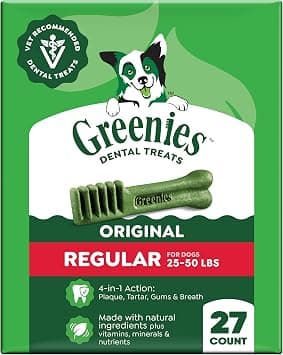
GREENIES Original Regular, 27 oz pack, 27 treats
The default for a reason. Greenies holds VOHC acceptance for plaque and for tartar, which most of the shelf does not, and the Regular size is built for a 25 to 50 lb dog at 88 kcal a treat by the manufacturer's own feeding instruction. At 27 treats in the 27 oz pack this works out to about $1.22 a day, the cheapest both-claims chew of the four. The texture is the trade: soft enough that a strong chewer finishes it inside a minute, which suits the dental mechanism and does nothing for occupation. Greenies sells the identical name in Teenie, Petite, Regular, Large and Jumbo at different counts, so the size band on the front of the pack is the part to read.
We may earn a commission on this link. It never changes the ranking.
- Size
- Regular, dogs 25 to 50 lb
- Pack
- 27 oz, 27 treats
- VOHC claim
- Plaque and tartar
- Calories
- 88 kcal per treat
- Cost per day
- About $1.22
- First ingredients
- Chicken, glycerin, wheat flour, wheat gluten
What works
- Holds both VOHC awards, plaque and tartar, not just tartar
- Cheapest per day of the four picks at roughly $1.22
- Five size bands, so a correct size exists for most dogs
- Calories published as an instruction to cut the meal by 88 kcal
What to know
- Wheat flour and wheat gluten sit second and third on the panel
- Chicken-based, so it is out for a poultry-restricted dog
- Highest calorie load of the four at the medium size
- Gone in under a minute for a strong chewer
$47.49
Price checked Sep 20, 2026
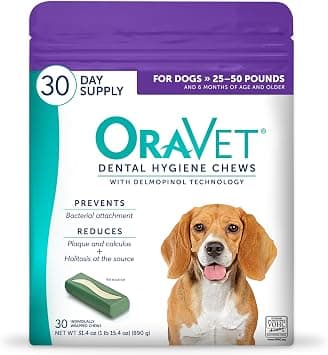
OraVet Dental Hygiene Chews, Medium 25 to 50 lb, purple pouch, 30 count
The only chew here that adds a pharmaceutical mechanism to the mechanical one. Boehringer Ingelheim builds it around delmopinol, an ingredient from human oral rinses, which coats the tooth surface and interferes with the bacterial attachment that starts plaque and calculus forming. Read the VOHC entry before paying the premium: OraVet's acceptance covers tartar alone, so the dual-action marketing runs ahead of the council's award. At $47.49 for 30 medium chews that is $1.58 a day, the dearest of the four, at 80.5 kcal each. The label instruction that matters most concerns sizing, and it warns plainly against under-dosing.
We may earn a commission on this link. It never changes the ranking.
- Size
- Medium, dogs 25 to 50 lb, purple pouch
- Pack
- 30 chews
- VOHC claim
- Tartar
- Calories
- 80.5 kcal per chew
- Cost per day
- About $1.58
- Active
- Delmopinol, barrier to bacterial attachment
What works
- Delmopinol barrier is a mechanism none of the other three has
- Price matches the brand's own retail listing
- Four size bands from 3.5 lb upward, each with a published calorie figure
- Label carries an explicit sizing and choking instruction
What to know
- VOHC acceptance covers tartar alone, despite the dual-action marketing
- Dearest per day of the four at roughly $1.58
- Wheat gluten is the first ingredient
- Contains pork gelatin, which rules it out on some household diets
$33.99
Price checked Sep 20, 2026
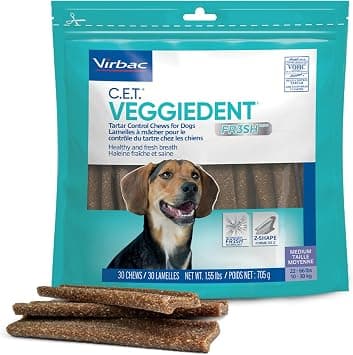
Virbac C.E.T. VEGGIEDENT FR3SH, Medium 22 to 66 lb, 30 chews
The pick for a restricted diet. Virbac states plainly that these contain no animal proteins and are gluten-free, which makes them the only both-claims chew of the four that a dog on a novel-protein elimination diet can eat without breaking it. The Z shape is built to be gripped front to back rather than crunched in one bite, and at 75 kcal for the medium it carries the lightest calorie load here. At $33.99 for 30 that is $1.13 a day, cheaper per chew than Greenies despite the higher pack price. The medium band spans 22 to 66 lb, so a 60 lb dog and a 25 lb dog get the same chew.
We may earn a commission on this link. It never changes the ranking.
- Size
- Medium, dogs 22 to 66 lb
- Pack
- 30 chews
- VOHC claim
- Plaque and tartar
- Calories
- 75 kcal per chew
- Cost per day
- About $1.13
- Formula
- No animal proteins, gluten-free, prebiotic added
What works
- No animal protein and no gluten, unique among the both-claims picks here
- Lowest calorie cost of the four at 75 kcal for a medium dog
- Cheapest per chew at about $1.13 a day
- Z shape resists being swallowed whole by a fast eater
What to know
- The 22 to 66 lb medium band leaves dogs at either end poorly matched
- Corn starch and rice flour base, so grain-free households are out
- Sold mainly through veterinary and specialist retail, so availability is patchy
- Too soft to work as occupation
$15.82
Price checked Sep 20, 2026
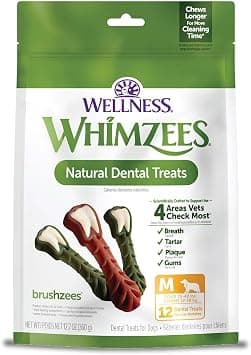
WHIMZEES Brushzees Medium, 12.7 oz bag, 12 count
The one to buy if the chew has to do two jobs. Brushzees is a hard, ridged potato-starch extrusion that takes real work to get through, and it holds both VOHC awards. The guaranteed analysis tells you what it is made of: 1 percent minimum protein and 2 percent minimum fat, because there is essentially no meat in it. Grain-free, and the only pick here free of wheat, corn and rice. The catch is calorie density. At 2,890 kcal per kg the Medium chew weighs 30g and carries 87 kcal, almost exactly a Greenies Regular, in a bag of 12 rather than 27. Check the chart before ordering, because Whimzees bands by weight differently from the others and Medium here means 25 to 40 lb.
We may earn a commission on this link. It never changes the ranking.
- Size
- Medium, dogs 25 to 40 lb
- Pack
- 12.7 oz bag, 12 chews
- VOHC claim
- Plaque and tartar
- Calories
- 87 kcal per 30g chew, 2,890 kcal/kg
- Cost per day
- About $1.32
- Base
- Potato starch, grain-free, no animal protein
What works
- Hard ridged texture lasts far longer, so it occupies as well as cleans
- Grain-free potato base with no wheat, corn or rice
- Holds both VOHC awards
- Lowest pack price of the four, which makes trying it cheap
What to know
- Only 12 chews to a bag, so the low pack price hides the daily cost
- 87 kcal in a chew with almost no protein or fat is a poor nutritional trade
- Medium band tops out at 40 lb, narrower than the others
- Too hard for a dog with existing dental pain or a fractured tooth
How they compare
| Chew | VOHC claim | Calories | Pack | Cost per day |
|---|---|---|---|---|
| GREENIES Original Regular | Plaque and tartar | 88 kcal | 27 treats, $32.98 | $1.22 |
| OraVet Medium | Tartar only | 80.5 kcal | 30 chews, $47.49 | $1.58 |
| C.E.T. VEGGIEDENT FR3SH Medium | Plaque and tartar | 75 kcal | 30 chews, $33.99 | $1.13 |
| WHIMZEES Brushzees Medium | Plaque and tartar | 87 kcal | 12 chews, $15.82 | $1.32 |
The spread in daily cost is 45 cents, about $164 over a year. The spread in calories is 13 kcal, roughly 12 percent of a 25kg dog's entire treat allowance. Both gaps are wider than the branding on the four bags implies.
Who each one is wrong for
Greenies is wrong for a wheat-restricted or poultry-restricted dog. Wheat flour and wheat gluten are the second and third ingredients and chicken is the first, so a dog on an elimination diet for either has no business eating one.
OraVet is wrong for a dog whose problem is inflamed gums. Its acceptance covers calculus, not plaque, and plaque is what sits at the gum margin causing inflammation. If a vet has flagged gingivitis rather than visible tartar, a both-claims chew is the better buy for less money.
VEGGIEDENT is wrong for a dog at the edges of its weight band. Medium covers 22 to 66 lb, which is a three-fold range in body mass being handed one chew. A 24 lb dog is better served by the small and a 60 lb dog by the large.
Brushzees is wrong for a dog with a sore mouth. It is the hardest of the four by a distance, which makes it the worst texture for a dog with a loose tooth, a fractured crown or painful gums. It also punishes anyone buying on the pack price without dividing by 12.
What is on the list and still not here
Purina DentaLife, Milk-Bone Brushing Chews and Blue Buffalo Dental Chews are all genuinely VOHC-accepted, all three on the tartar claim alone. They are cheaper per chew and reasonable buys on that basis. They missed the four picks because the both-claims products land within a few cents a day.
Rawhide is a thinner story than the shelf suggests: exactly two rawhide products appear anywhere on the dogs list, and the wider category carries a swallowing and obstruction risk that acceptance leaves in place.
The real problem is the hard chews marketed for dental benefit that were never submitted at all. The 2019 AAHA Dental Care Guidelines are blunt about them, finding no strong rationale for offering hard treats such as antlers, synthetic bones or natural bones that could damage the structural integrity of the tooth. The two-second test that predicts which chews break teeth sorts that aisle faster than any label, and where the goal is occupation, a firm rubber toy built for a power chewer does it without the calories.
What a chew cannot do
AAHA is equally direct about the ceiling on home care. Brushing clears plaque while leaving calculus behind, it has to be daily to do anything, and even daily brushing leaves the need for anesthetised oral exams, radiographs and treatment fully intact. A chew sits one rung below brushing on that ladder.
Periodontal disease is a veterinary diagnosis, and the part that matters most sits under the gumline where no chew reaches and no owner can see. Bad breath, a dog chewing on one side, dropping food, or pawing at its mouth is a reason to book an appointment. Treat the chews above as maintenance between professional cleanings, and expect the same gap between a seal and a proven outcome across the supplement aisle.
Questions people actually ask
Does a VOHC seal mean the chew works?
It means the manufacturer submitted trial data against a published numerical standard and the council accepted it, which is more than any unaccepted product has shown. The 2019 AAHA Dental Care Guidelines state that many products make plaque and calculus claims and only those accepted by the VOHC have met preset standards.
Why do some accepted chews say tartar and others say plaque and tartar?
The council awards the two claims separately and prints which one a product holds. Tartar-only means the submitted data cleared the calculus threshold but not the plaque one. Plaque is the soft film that inflames gums, so a both-claims product is the broader result.
Can a dental chew replace brushing?
No. AAHA notes that brushing itself removes plaque rather than calculus, and that even daily brushing leaves the need for anesthetised exams and cleaning intact. A chew is the layer below brushing, useful mainly because owners actually do it.
How many calories does a daily dental chew add?
On the four picks here, 75 to 88 kcal for a medium dog, which is roughly three quarters of a 25kg dog's ten percent treat allowance. Subtract it from meals rather than adding it on top.
What size should I buy?
The one matching your dog's actual weight on that brand's own chart, and never a smaller one to save money. The bands differ between brands: Whimzees Medium is 25 to 40 lb, Greenies Regular is 25 to 50 lb, and VEGGIEDENT Medium is 22 to 66 lb.
Sources
- VOHC accepted products index
- VOHC Accepted Products for Dogs, August 2026 table
- Cornell Riney Canine Health Center: periodontal disease
- 2019 AAHA Dental Care Guidelines for Dogs and Cats
- GREENIES Original Regular product page, ingredients and feeding instruction
- Boehringer Ingelheim: ORAVET Dental Hygiene Chews
- OraVet Dental Hygiene Chews label, calories per size and sizing caution
- Virbac C.E.T. VEGGIEDENT FR3SH product specification
- WHIMZEES Brushzees ingredients and feeding guidance
- WHIMZEES Brushzees Medium calorie content and guaranteed analysis
As an Amazon Associate we earn from qualifying purchases. We earn a commission on some links, at no extra cost to you. It never changes which products we recommend or the order they appear in. Full disclosure

Who wrote this
Tess Lindqvist
Writer, cat products and everyday health
Tess Lindqvist writes the cat side of PetGearSearch, plus the health-adjacent categories where a label makes a claim the evidence has to back. The question asked of every product is the one owners actually ask at 3am: will the animal use it, and does it do the thing the box says.
The standard
How this guide was built
- The full product specification, ingredient panel or material spec, read end to end rather than summarised from a retail listing.
- The veterinary and regulatory guidance that applies to the category, cited by name and linked — AAFCO nutrient profiles, WSAVA manufacturer guidelines, the VOHC accepted-product list.
- Aggregated owner reviews at volume across retailers, read for the pattern rather than the anecdote, with deliberate attention to the one-star reports where the failure modes live.
- Every price checked against the live listing on the date printed beside it.