Best Puzzle Feeders and Slow Feeders for Dogs and Cats
Five food puzzles sorted by the job they do: slowing a gulper, occupying a bored dog, or giving an indoor cat the end of a hunt.
By Tess Lindqvist, writer, cat products and everyday health
Published Sep 23, 2026 · 13 min read
- Toys & Play
- 5 products compared
In this guide
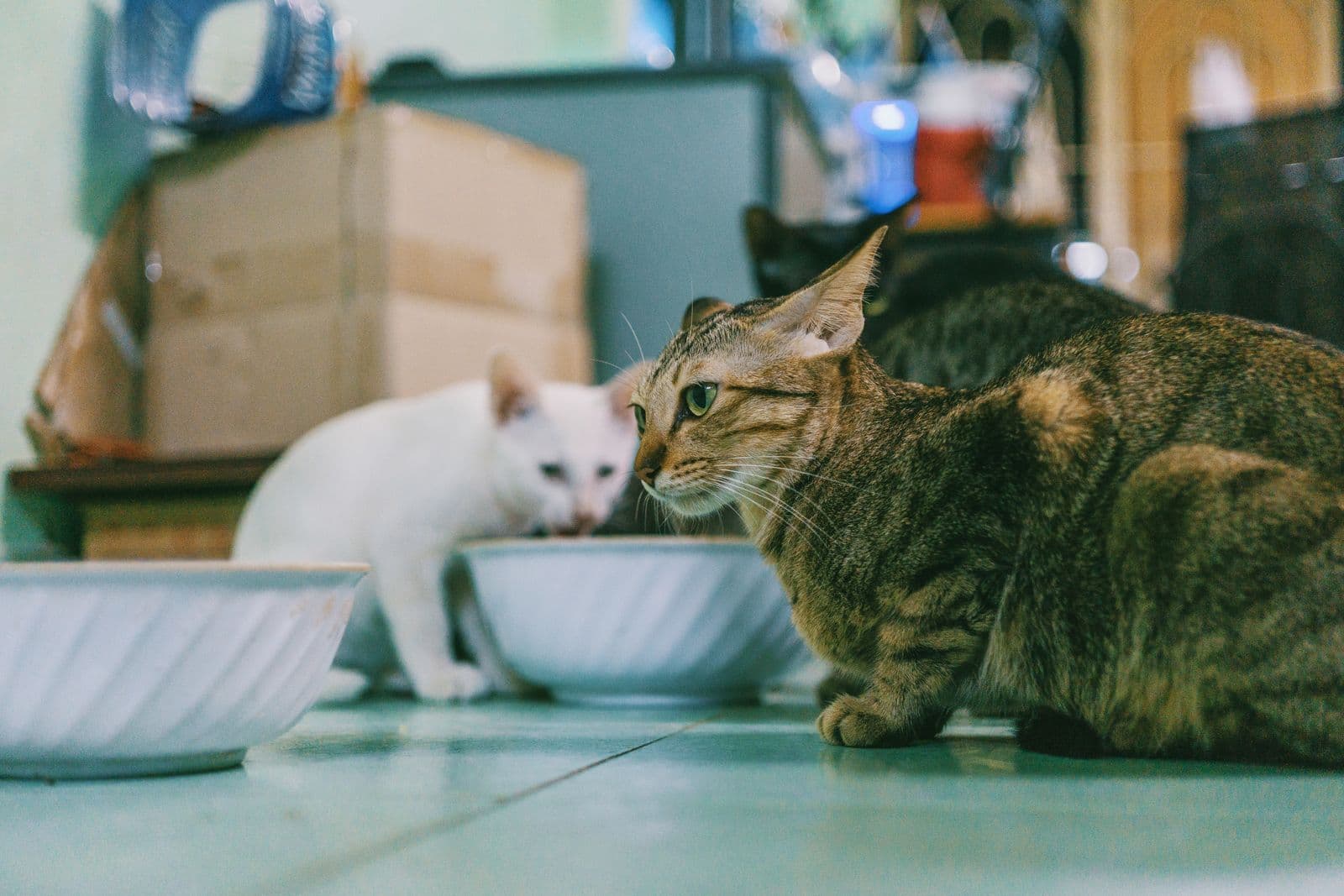
A food puzzle is three different products sold under one name, and buying the wrong one of the three is why so many end up unused. A slow feeder bowl solves speed. A dispensing toy solves boredom. A foraging feeder for a cat solves something more specific: an indoor cat's day has no hunt in it, and the bowl removes the only part of the sequence the cat still gets to finish.
In their review of feeding for feline behavioural wellbeing, Mikel Delgado and Leticia Dantas note that cats allowed to set their own schedule eat roughly 8 to 16 small meals a day, that a mouse is worth about 30 kcal, and that only around a third of a cat's hunting attempts end in a kill. A cat, in other words, is built to work for many small portions. Twice-daily bowl feeding is the least natural arrangement it could be given.
Dogs arrive at a puzzle from the opposite direction. The American College of Veterinary Surgeons describes gastric dilatation-volvulus as commonly associated with rapid ingestion of large meals, and lists a single large meal once a day among the risk factors, alongside a deep chest, age and an affected relative. A slow feeder does not prevent bloat and nothing here should be bought as if it did. It does address the one factor on that list an owner controls at every meal.
We cover what a puzzle can and cannot do for behaviour in our guide to whether puzzle feeders work at all.
Pick the job before the puzzle
Speed. For a dog that finishes a bowl in under a minute, the answer is a slow feeder bowl used for every meal.
Occupation. For a dog left alone or one that pesters in the evening, the answer is a dispensing toy that makes a meal take ten or fifteen minutes of pushing.
Foraging. For an indoor cat, the answer is food split into small portions and spread out, so that eating involves finding. Delgado and Dantas divide cat puzzles into two kinds: mobile ones, filled with dry food and batted around to release it, and stationary ones, with wells or tubes the cat fishes food out of. If a cat ignores one kind, try the other before giving up on puzzles.
Difficulty. The review is explicit that difficulty should match the animal's ability and that a first puzzle should need little effort to release food. Start open, start easy, and raise it only when the animal is finishing without hesitation.
The picks
$8.47
Price checked Sep 23, 2026
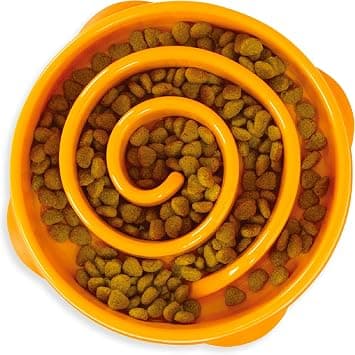
Outward Hound Fun Feeder Slo Bowl, Medium (2 cup)
Wrong for a bored dog, because a slow bowl has no problem in it to solve, and wrong for a giant breed, which needs the large size. For the dog that inhales its dinner it is the first thing to buy, and the only thing on this page to use at every meal. The ridged maze makes the dog eat around obstacles rather than scoop, Outward Hound claims up to ten times longer at the bowl, and the medium holds 2 cups, a full meal for many small and medium dogs fed twice a day. It takes wet or dry food, goes in the top rack of a dishwasher, and the listing sits inside Outward Hound's own $6.99 to $14.99 list range for the line.
We may earn a commission on this link. It never changes the ranking.
- Capacity
- 2 cups (medium)
- Also sold
- 3/4 cup small, 3 to 4 cup large
- Food
- Wet or dry
- Base
- Non-slip
- Material
- BPA, PVC and phthalate free plastic
- Cleaning
- Top-rack dishwasher safe
- Linked variant
- Medium, orange, swirl pattern
What works
- Solves eating speed with no training at all
- Takes wet food, which none of the other four picks here do
- Cheap enough to own two and rotate through the dishwasher
- Shallow enough for a flat-faced dog or a cat
What to know
- No occupation value once the dog learns the maze
- Plastic, so not for a dog that chews its bowl
- Ridges take more cleaning than a plain bowl after wet food
$24.91
Price checked Sep 23, 2026
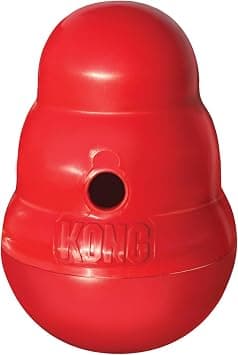
KONG Wobbler, Large
Wrong for a dog under 30 lb, which should have the small, and wrong for a small flat or a household that sleeps near hard floors, because a weighted hard plastic toy knocking across a hard floor is noisy. KONG rates the large for dogs of 30 to 65 lb and says it takes up to 1 cup of kibble per filling, so a full meal for a lot of dogs goes in one load. It sits upright on a weighted base and dispenses a few pieces each time it is nosed over. KONG is plain that it is not a chew toy and is for supervised use. The listing is a few cents under KONG's own $24.99.
We may earn a commission on this link. It never changes the ranking.
- Size linked
- Large
- Rated for
- Dogs 30 to 65 lb
- Dimensions
- 5.25 x 5.25 x 7.5 in
- Capacity
- Up to 1 cup dry food per filling
- Opening
- Twist-off top
- Cleaning
- Top-shelf dishwasher safe
- Maker's warning
- Not a chew toy, supervised use only
What works
- A whole kibble meal in one filling
- Weighted base means it rights itself and keeps the dog working
- Two pieces and a screw thread, so it actually gets cleaned
- Priced at KONG's own list
What to know
- Noisy on hard floors
- Dry food and small treats only, per KONG's filling instructions
- Not for a dog that chews hard plastic
- Too big for small breeds
$16.95
Price checked Sep 23, 2026
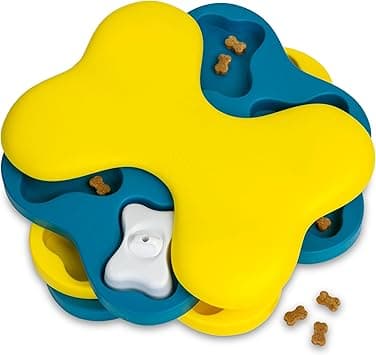
Outward Hound Nina Ottosson Dog Tornado
Wrong for a dog that chews its toys, and wrong as a meal feeder, because twelve compartments hold treats or a handful of kibble rather than dinner. It is also wrong to leave down with a dog alone, which Outward Hound says outright. As a supervised ten-minute session it is the most demanding thing here. Three stacked layers spin to expose twelve compartments, and three bone-shaped covers add a second step once the dog has the spinning worked out. It is graded level 2, intermediate, by Nina Ottosson, so a dog new to puzzles should see it with the covers off. Outward Hound lists it at $19.99, above this listing.
We may earn a commission on this link. It never changes the ranking.
- Difficulty
- Level 2 (intermediate)
- Layers
- 3 spinning tiers
- Compartments
- 12
- Extras
- 3 bone-shaped covers
- Diameter
- 9.8 in
- Material
- BPA, PVC and phthalate free
- Cleaning
- Hand wash
What works
- Real problem-solving rather than just slow eating
- Difficulty adjusts with the covers
- Below the maker's list price
What to know
- Holds treats, not a meal
- Hand wash only
- Must be supervised and put away after
- A chewer will destroy the covers and may swallow a piece
$15.99
Price checked Sep 23, 2026
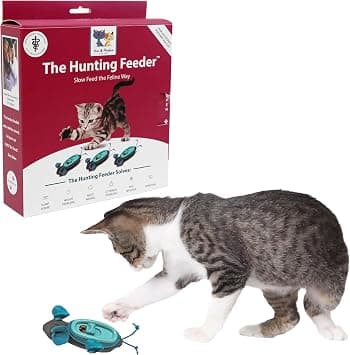
Doc & Phoebe's Indoor Hunting Cat Feeder (3 mice)
Wrong for a wet-fed cat, because the mice dispense kibble or dry treats through small holes and nothing else, and wrong for a cat that has never used a puzzle and is given the mice full on day one. For a dry-fed indoor cat it is the closest thing on this page to what that review describes: small portions, spread out, each one found and batted before it pays out. The set is three mice and a scoop, and the maker's instruction is three mice, twice a day, hidden around the house rather than set down in one spot. The listing is below the $20.75 to $23.25 that independent pet stores are charging.
We may earn a commission on this link. It never changes the ranking.
- In the set
- 3 feeder mice and a scoop
- Puzzle type
- Mobile, batted to release food
- Food
- Kibble or dry treats
- Use
- Hidden around the home, refilled twice a day
- Linked version
- SPOT (Ethical Products) set
What works
- Turns a meal into several small found portions, the way cats eat by choice
- Spreads eating across rooms, which adds movement to an indoor day
- Cheap, and small enough to hide anywhere
- Suits a nervous cat that will not eat at a busy bowl
What to know
- No use at all for wet food
- Mice hidden around a home end up under furniture
- Measuring a full day of kibble into small mice takes a minute every morning
- A cat new to puzzles needs the easy introduction or it will not engage
$27.99
Price checked Sep 23, 2026
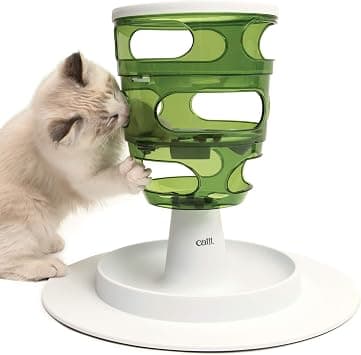
Catit Senses 2.0 Food Tree
Wrong for a small flat, because the collector tray spreads it to 14.8 inches square, and wrong for a wet-fed cat, since it is designed for dry food and treats. For a cat that will not chase a rolling toy it is the natural stationary alternative: food goes in the narrow top, the cat paws it down three tiers through openings all round, and a disc inside has three settings that change how freely food drops. Start on the most open setting. Catit sells its collector tray as whisker-friendly, and the review is blunt that there is no empirical evidence for whisker stress, so buy it for the tiers rather than the tray. This is the 2.0 model Catit sells as number 43151. The listing sits inside the $24.99 to $37.99 range that independent retailers charge.
We may earn a commission on this link. It never changes the ranking.
- Model
- Senses 2.0 Food Tree, 43151
- Puzzle type
- Stationary
- Tiers
- 3, with openings all round
- Difficulty
- 3 disc settings
- Dimensions
- 14.8 x 14.8 x 13.1 in (W x D x H)
- Food
- Dry food and treats
- Material
- BPA free
What works
- Stationary, so it suits cats that will not chase a mobile puzzle
- Difficulty adjusts without buying anything else
- Wide base, which Catit specifies for stability
What to know
- Takes a lot of floor for a feeder
- Dry food only
- Several pieces to take apart and wash
How they compare
| Puzzle | For | Job | Food | Holds a full meal? |
|---|---|---|---|---|
| Outward Hound Fun Feeder Slo Bowl | Dogs and cats | Slows eating | Wet or dry | Yes, 2 cups |
| KONG Wobbler, Large | Dogs 30 to 65 lb | Occupation | Dry | Yes, up to 1 cup per fill |
| Nina Ottosson Dog Tornado | Dogs | Problem-solving | Treats or kibble | No |
| Doc & Phoebe's Hunting Feeder | Cats | Foraging, mobile | Dry | Across 3 mice, twice a day |
| Catit Senses 2.0 Food Tree | Cats | Foraging, stationary | Dry | Yes |
Who each one is wrong for
The Slo Bowl is wrong for any animal whose problem is boredom. It changes how fast a meal goes down and does nothing for the hours after.
The Wobbler is wrong for small dogs, for hard-floored flats at night, and for any dog that has ever destroyed a hard plastic toy.
The Tornado is wrong unsupervised, wrong as a meal feeder, and wrong for a beginner with the covers on.
The Hunting Feeder is wrong for wet-fed cats and for anyone who will not refill it daily. The Food Tree is wrong for small spaces and for cats that already scatter food for fun.
Every item here is wrong as a weight-loss tool on its own, because a puzzle changes the speed at which calories arrive and leaves the total alone. The number that matters is the portion, and the arithmetic behind a dog's feeding chart and the equivalent sum for a cat come before any purchase. Cornell's Riney Canine Health Center makes the point that "heaping" portions quietly add calories, and a scoop of kibble poured into a puzzle is still a scoop.
Setting a puzzle up so it lasts
Use the meal. Measure the day's food and take the puzzle's share out of it. A puzzle stuffed with treats on top of dinner is a weight gain plan.
Feed apart in a multi-animal home. The review cites a survey in which almost half of multi-cat households gave several cats a single food dish, and notes that a cat made to share a feeding station may eat under stress instead of skipping the meal. Puzzles concentrate that problem, because the slow eater is the one that loses out. One puzzle per animal, in separate spaces.
Pair it with play for a cat. A food puzzle covers the end of the hunt. The stalk and pounce at the start still have to come from somewhere, and a short wand session before the meal is the part of the prey sequence a puzzle cannot supply.
Match the material to the mouth. None of the hard plastic puzzles here belongs with a dog that chews them. For a power chewer, stick to firm rubber and apply the same thumbnail test used for chew toys.
Read the peanut butter label. Spreads are a popular way to make a puzzle harder, and the ASPCA lists xylitol, a sweetener in some of them, as a cause of low blood sugar and possible liver damage.
Questions people actually ask
Is a slow feeder or a puzzle toy better for a dog that eats too fast?
A slow feeder bowl. It works at every meal with no learning curve, takes wet food, and the goal is simply a longer meal. A puzzle toy is the better buy for a bored dog, and many households use both.
Will a slow feeder bowl prevent bloat?
No product prevents bloat. The American College of Veterinary Surgeons associates it with rapid ingestion of large meals, and a slow bowl addresses the speed. Breed, chest depth, age and family history are unchanged by any bowl, so a dog at high risk is a conversation for your vet.
Can I put wet food in a cat puzzle feeder?
In the Slo Bowl or a lick mat, yes. In the Hunting Feeder mice or the Food Tree, no, because both are built for dry food. The review of feline feeding notes that puzzles in general can work with wet or dry food, so a wet-fed cat needs a shallow stationary type.
My cat ignores the puzzle. What should I change?
Make it trivially easy. Set the Food Tree to its most open setting, leave a mouse in plain view with kibble falling out, and use it just before a meal when the cat is hungry. If a mobile puzzle still fails, try a stationary one.
How many puzzle feeders does one animal need?
Two or three in rotation. For a cat, several small feeding spots around the home suit the way cats eat better than one hard puzzle in the kitchen.
Sources
- Delgado M, Dantas LMS. Feeding Cats for Optimal Mental and Behavioral Well-Being. Veterinary Clinics of North America: Small Animal Practice, 2020, 50(5), 939-953
- American College of Veterinary Surgeons: gastric dilatation-volvulus
- Cornell Riney Canine Health Center: obesity and weight loss in dogs
- ASPCA: people foods to avoid feeding your pets, including xylitol
- Outward Hound Fun Feeder Slo Bowl specification
- KONG Wobbler specification
- Outward Hound Nina Ottosson Dog Tornado specification
- Ethical Pet: Doc & Phoebe's Indoor Hunting Feeder
- Catit Senses Food Tree specification
As an Amazon Associate we earn from qualifying purchases. We earn a commission on some links, at no extra cost to you. It never changes which products we recommend or the order they appear in. Full disclosure

Who wrote this
Tess Lindqvist
Writer, cat products and everyday health
Tess Lindqvist writes the cat side of PetGearSearch, plus the health-adjacent categories where a label makes a claim the evidence has to back. The question asked of every product is the one owners actually ask at 3am: will the animal use it, and does it do the thing the box says.
The standard
How this guide was built
- The full product specification, ingredient panel or material spec, read end to end rather than summarised from a retail listing.
- The veterinary and regulatory guidance that applies to the category, cited by name and linked — AAFCO nutrient profiles, WSAVA manufacturer guidelines, the VOHC accepted-product list.
- Aggregated owner reviews at volume across retailers, read for the pattern rather than the anecdote, with deliberate attention to the one-star reports where the failure modes live.
- Every price checked against the live listing on the date printed beside it.