Best Fish Oil for Dogs, Priced by the EPA and DHA You Actually Get
Three fish oils for dogs that print their EPA and DHA, costed per 1,000mg of the pair, with who each one is wrong for and what Cornell and CSU say about dose.
By Tess Lindqvist, writer, cat products and everyday health
Published Oct 17, 2026 · 13 min read
- Supplements & Health
- 3 products compared

In this guide
Fish oil is the rare dog supplement where the evidence and the shelf point the same way, and the shelf still manages to mislead. Cornell's Riney Canine Health Center quotes Dr. Christopher Frye saying that the supplement with the most support in the literature for joint health is omega-3 fatty acids from fish oil. Dr. Joseph Wakshlag, quoted on the same page, says few joint supplements other than fish oil have been definitively shown to help slow the degeneration.
The trouble is the label. A bottle can lead with total oil, or with total omega-3, or with an "omega 3-6-9" blend, and none of those is the figure that matters. The dose arithmetic for fish oil is worked through in full elsewhere on this site. This guide takes the next step and narrows the aisle to three products that print the useful number, then prices each one by it.
The one number to shop by
Combined EPA and DHA. Today's Veterinary Practice, in a review by board-certified veterinary nutritionists Donna Raditic and Laura Gaylord, describes EPA and DHA as the active ingredient in common pet fish oil supplements. Colorado State University's veterinary hospital puts it more bluntly on its dosing chart: quality products display amounts of EPA and DHA on the label.
So the comparison below ignores the big number on the front. Each product's EPA and DHA per serving comes from the maker's own published analysis, and the price is divided by it to give a cost per 1,000mg of EPA plus DHA. It puts a scoop, a pump and a capsule on the same scale.
What the dose guidance says
CSU's chart sets a maximum of 310mg of EPA and DHA per kilogram of body weight to the power 0.75 per day, for dogs with osteoarthritis. The chart converts that into plain figures: 965mg a day for a 10lb dog, 1,623mg for 20lb, 2,200mg for 30lb and 2,730mg for 40lb. CSU adds two qualifiers that are easy to skip. The maximum is not tolerated by every dog and a lower dose may be preferable, and the page suggests starting near a quarter of the maximum.
The Today's Veterinary Practice review gives a wider therapeutic range of 50 to 220mg per kilogram of body weight, with the highest dose reserved for osteoarthritis. It also cites the National Research Council's safe upper limit for dogs of 280mg of combined EPA and DHA per 100 kcal of diet.
None of this is a dosing instruction, and nothing here should be read as one. Neither writer on this site is a veterinarian. The figures are what CSU and the review state, and the point of printing them is to show how far apart products sit. The right amount for a given dog is a conversation for its vet, particularly for a dog already on pain medication.
Who should not start here
Cornell's page carries a line worth taking seriously before buying anything: Frye says he never recommends this supplement in overweight dogs, and suggests adding fish oil once the dog is at a healthy weight. Fish oil is fat. A dog carrying extra weight gets more from getting the daily calories right than from a pump of oil on top of the same meal.
The review lists the effects to know about at higher doses: altered platelet function, gastrointestinal upset, slower wound healing and weight gain. CSU names loose stools and vomiting as the signs to watch when the amount goes up. A dog facing surgery, a dog with a history of pancreatitis, and a dog on any medication that affects clotting all belong in the vet's office before the bottle comes home.
The three worth buying
$29.99
Price checked Oct 17, 2026
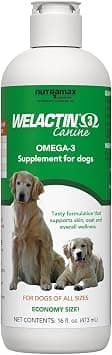
Nutramax Welactin Omega-3 Fish Oil Liquid for Dogs, 16 fl oz
The strongest serving of the three. Welactin's own page states that one 6mL scoop contains 1,610mg of total omega-3 fatty acids, of which 1,330mg is EPA plus DHA. That is the figure that matters, and it is printed plainly. The label chart runs from half a scoop every other day for a 5 to 9lb dog up to two and a half scoops for a dog over 115lb, with one scoop for 20 to 44lb. For a 20lb dog, one scoop sits below CSU's 1,623mg osteoarthritis maximum. At $29.99 for 16 fl oz, about 79 scoops, it works out to roughly $0.29 per 1,000mg of EPA and DHA, and the price is in line with what other pet retailers charge for the same bottle. Ask your vet before starting it, and bring the label.
We may earn a commission on this link. It never changes the ranking.
- Size
- 16 fl oz (about 473 mL)
- Serving
- One 6mL scoop, scoop included
- EPA + DHA per scoop
- 1,330mg
- Total omega-3 per scoop
- 1,610mg
- Cost per 1,000mg EPA + DHA
- About $0.29
- Labelled for
- Dogs
What works
- Highest EPA and DHA per serving of the three at 1,330mg a scoop
- Weight chart printed on the maker's page, from 5lb to over 115lb
- Scoop measures a fixed volume, so the dose is repeatable
- Price matches other pet retailers
What to know
- The maker publishes EPA and DHA combined rather than separately
- Scoop sizes are coarse for a small dog, where half a scoop is the smallest step
- Liquid oil on food is messy and some dogs refuse it
- Dog formula only, so a cat in the house needs a separate product
$40.00
Price checked Oct 17, 2026
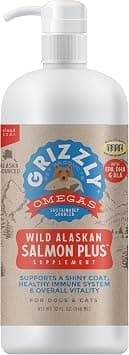
Grizzly Salmon Plus Omega 3-6-9 Supplement for Dogs and Cats, 32 oz
The cheapest EPA and DHA here by a clear margin. Grizzly's guaranteed analysis gives 598mg of EPA and 368mg of DHA per teaspoon, so 966mg of the pair, from salmon, pollock and whitefish oil caught in Alaskan waters. The name oversells the blend. Omega-9 makes up 25 percent of the oil and omega-6 another 2 percent, and neither is the reason to buy fish oil. Grizzly states 38 kcal per teaspoon, which is a number to subtract from meals on a dog watching its weight. The catch is the size. Grizzly says an opened bottle should be finished within 90 days, and a 32 oz bottle holds about 192 teaspoons, so a single small dog will not get through it in time. At $40.00 it costs about $0.22 per 1,000mg of EPA and DHA, below the $48.99 list price at other pet retailers. Ask your vet before starting it.
We may earn a commission on this link. It never changes the ranking.
- Size
- 32 oz pump bottle
- EPA per teaspoon
- 598mg
- DHA per teaspoon
- 368mg
- Calories
- 38 kcal per teaspoon
- Cost per 1,000mg EPA + DHA
- About $0.22
- Use within
- 90 days of opening
What works
- Lowest cost per 1,000mg of EPA and DHA of the three
- EPA and DHA printed separately, per teaspoon
- Calories stated, which makes the meal adjustment simple
- Smaller 4, 8 and 16 oz bottles exist for lighter households
What to know
- 32 oz is too much for one small dog to finish inside the 90-day window
- Omega 3-6-9 branding pads the label with fatty acids that are not the point
- Pump volume is not published on the maker's page, so check the label chart
- The calories add up quickly at a joint-level dose
$19.51
Price checked Oct 17, 2026
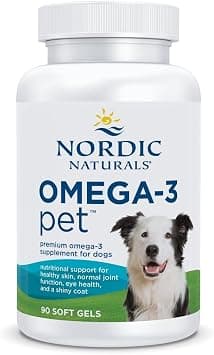
Nordic Naturals Omega-3 Pet Soft Gels for Dogs, 90 count
The tidy option, and the dearest per milligram. Each 1,000mg soft gel carries 155mg of EPA and 100mg of DHA, 255mg of the pair, in triglyceride form, from anchovy, sardine, mackerel and herring oil. The maker's chart gives one soft gel for 10 to 19lb and two for 20 to 39lb, rising to six for 111 to 130lb. Two soft gels for a 20lb dog come to 510mg, roughly a third of CSU's osteoarthritis maximum for that weight, which is a reasonable maintenance figure and well short of a joint-level one. Getting near the higher figures takes a handful of capsules a day. At $19.51 for 90 soft gels it costs about $0.85 per 1,000mg of EPA and DHA, nearly four times the Grizzly figure, and the price matches what Walmart charges for the same 90-count bottle. Ask your vet before starting it.
We may earn a commission on this link. It never changes the ranking.
- Count
- 90 soft gels
- EPA per soft gel
- 155mg
- DHA per soft gel
- 100mg
- Total omega-3 per soft gel
- 320mg
- Cost per 1,000mg EPA + DHA
- About $0.85
- Form
- Triglyceride, in a gelatin capsule
What works
- No measuring, no spills and no open oil to go stale on the counter
- EPA and DHA printed separately per capsule
- Weight chart runs from 10lb to 130lb
- Easy to hide in a pill pocket or a piece of food
What to know
- Most expensive per 1,000mg of EPA and DHA by a wide margin
- A large dog at a joint-level amount would need many capsules a day
- 90 capsules last a month or less for a dog over 40lb
- Gelatin capsule, so it does not suit a household avoiding animal gelatin
How they compare
| Fish oil | Serving | EPA + DHA per serving | Price | Per 1,000mg EPA + DHA |
|---|---|---|---|---|
| Nutramax Welactin liquid, 16 fl oz | 6mL scoop | 1,330mg | $29.99 | About $0.29 |
| Grizzly Salmon Plus, 32 oz | 1 teaspoon | 966mg | $40.00 | About $0.22 |
| Nordic Naturals Omega-3 Pet Soft Gels, 90 count | 1 soft gel | 255mg | $19.51 | About $0.85 |
The sticker price ranks these backwards. The cheapest bottle on the shelf is the most expensive way to buy EPA and DHA, and the dearest bottle is the cheapest.
Who each one is wrong for
Welactin is wrong for a toy breed. The smallest step on the chart is half a scoop every other day, and a dog under 5lb is off the chart entirely. For a very small dog a capsule with a fixed, smaller amount is easier to get right.
Grizzly is wrong for a one-small-dog household. The maker's 90-day window after opening is the limit that matters, and a dog getting a fraction of a teaspoon a day will leave most of a 32 oz bottle to oxidise. Grizzly sells 4, 8 and 16 oz bottles, and the smaller one is the better buy even at a worse unit price.
Nordic Naturals is wrong for a big dog on a joint plan. At 255mg a capsule, the amounts CSU charts for a 40lb dog run past ten capsules a day. That is a lot of capsules, a lot of gelatin, and a 90-count bottle that empties in nine days or less.
All three are wrong for a dog carrying extra weight. That is Cornell's point, and it costs nothing to follow.
Freshness and the bottle size trap
Oxidised fish oil is the hidden cost in this category. CSU advises looking for a product that evaluates purity and freshness through third-party testing. Grizzly's own page gives at least 20 months unopened and 90 days once opened, and says the oil can sit at room temperature away from sunlight or go in the fridge. The cost per milligram in the table assumes the whole bottle gets used before that clock runs out. If it does not, the real price is higher than the table says.
What the NASC seal does and does not tell you
Cornell's page makes a point that applies to every bottle here: supplements are not regulated like medications, and products may not contain what they state on the label. It names the National Animal Supplement Council as the body that monitors its members so that ingredients match the label.
The NASC's own page sets out what holding the Quality Seal requires: a written quality control manual, a system for logging adverse events and complaints, compliance with labelling guidelines, the FDA-recommended caution statements where they apply, and random product testing by an independent lab. Nothing on that page says the seal certifies that a product works. What the NASC seal covers, line by line, is worth reading before paying extra for the logo. Check the bottle in hand for the seal itself.
Where fish oil fits in a joint plan
For an older dog with stiff joints, fish oil is one piece of a plan that a vet should be running. Wakshlag, on the Cornell page, says fish oil may help reduce the dose of anti-inflammatory pain medication a dog needs. That is a reason to tell the vet about it, not a reason to change a prescription at home. The other joint supplements with any evidence behind them sit alongside it, and the glucosamine and chondroitin dosing guide covers the products that most often get bought instead of fish oil rather than with it.
Frye also notes that omega-3s should generally be given as a separate product for joint health, because the chews that include them usually contain little.
Questions people actually ask
What should I look for on a dog fish oil label?
The milligrams of EPA and DHA per serving. CSU's veterinary hospital says quality products display both on the label. Total oil, total omega-3 and omega 3-6-9 figures are not the number to compare.
How much fish oil does a dog need?
That is a question for the dog's vet. CSU's chart sets an osteoarthritis maximum of 310mg of EPA and DHA per kilogram to the power 0.75 per day, about 1,623mg for a 20lb dog, and suggests starting near a quarter of that. A healthy dog on a maintenance amount needs far less.
Is liquid fish oil better than capsules?
Not in itself. Liquids are usually cheaper per milligram of EPA and DHA and easier to scale for a big dog. Capsules are tidier and need no measuring. Compare the cost per 1,000mg of EPA and DHA rather than the format.
Can fish oil make a dog gain weight?
Yes. It is fat, and Grizzly states 38 kcal per teaspoon for its oil. Cornell quotes Dr. Christopher Frye saying he never recommends fish oil in overweight dogs, and suggests adding it once the dog is at a healthy weight.
Does the NASC seal mean a fish oil works?
No. The NASC describes the seal as covering quality control, adverse event reporting, labelling and random independent product testing. It is an assurance about the bottle, not about the effect.
Sources
- Cornell Riney Canine Health Center: how joint supplements can help with orthopedic conditions
- CSU Veterinary Health System: canine fish oil dosing chart
- Today's Veterinary Practice: fish oil dosing in pet diets and supplements, Raditic and Gaylord
- NASC Quality Seal requirements
- Welactin Canine Omega-3 liquid, guaranteed analysis and weight chart
- Grizzly Salmon Plus, guaranteed analysis and storage
- Nordic Naturals Omega-3 Pet Soft Gels, supplement facts and weight chart
As an Amazon Associate we earn from qualifying purchases. We earn a commission on some links, at no extra cost to you. It never changes which products we recommend or the order they appear in. Full disclosure

Who wrote this
Tess Lindqvist
Writer, cat products and everyday health
Tess Lindqvist writes the cat side of PetGearSearch, plus the health-adjacent categories where a label makes a claim the evidence has to back. The question asked of every product is the one owners actually ask at 3am: will the animal use it, and does it do the thing the box says.
The standard
How this guide was built
- The full product specification, ingredient panel or material spec, read end to end rather than summarised from a retail listing.
- The veterinary and regulatory guidance that applies to the category, cited by name and linked — AAFCO nutrient profiles, WSAVA manufacturer guidelines, the VOHC accepted-product list.
- Aggregated owner reviews at volume across retailers, read for the pattern rather than the anecdote, with deliberate attention to the one-star reports where the failure modes live.
- Every price checked against the live listing on the date printed beside it.