Best Cat Nail Clippers: Scissor or Guillotine, Matched to the Claw
A cat's claw is narrow, curved and retractable, and the clipper decides how cleanly it cuts. Which style suits which cat and owner, and four worth buying.
By Marin Okafor, editor, dog gear and nutrition labels
Published Oct 5, 2026 · 12 min read
- Grooming
- 4 products compared
In this guide
Most cat nail trims go wrong before the clipper closes. The cat was restrained harder than it needed to be, the claw was never fully extended, or the owner tried to finish all eighteen claws in one sitting. A better clipper fixes none of that. What a clipper does decide is whether a narrow, curved claw is sheared cleanly or squeezed until it splinters, and whether you can see the pink of the quick at the moment you commit to the cut.
That makes the choice simpler than the cat claw care aisle suggests. There are two mechanisms worth considering, and the right one depends far more on your hands and your cat's tolerance than on the price.
The two mechanisms, and who each is wrong for
VCA Animal Hospitals sorts pet nail clippers into two working families, and says plainly that either can be used safely on a cat.
Guillotine clippers feed the claw through a ring. When you squeeze the handles, a blade rises from the base of the ring and slices across the claw. Washington State University's Veterinary Teaching Hospital calls the guillotine type the easiest to use in cats, and its technique is specific: place the tip of the claw in the stationary ring, hold the clipper perpendicular to the claw, keep the cutting blade on your side rather than the cat's, and cut top to bottom. The ring works as a rough length gauge, which is why a guillotine suits an owner who is still learning where to stop. It is wrong for anyone who cannot see past the head of the tool at the moment of the cut, because the claw disappears inside it, and it is wrong for an owner who feeds the claw in from the wrong side.
Scissor-style clippers have two blades that meet like a small pair of shears, usually with a notch or curve that cradles the claw. VCA notes that many owners prefer small scissor-style clippers designed specifically for cats, and WSU names the scissors type as the best tool for dewclaws, the inside claws on the front legs that never touch the ground and therefore never wear down. Scissors keep the claw in plain view right up to the blade. They are wrong for a shaky or rushed grip, because nothing on a scissor clipper stops you taking more than you meant to.
There is no third category worth paying for. A dog-sized plier clipper crowds a cat's claw behind its own jaws, and dog nail clippers and grinders are built for a thicker, fixed nail that wears on pavement. A cat's claw is a different structure. VCA does say a human nail clipper can work in a pinch, but recommends keeping separate clippers for the cat and for people to avoid spreading infection, and a clipper shaped for the claw is cheap enough that there is little reason to improvise.
What to check before you buy
Blade thickness and sightline. The thinner the blades and the more open the head, the easier it is to see the pink quick through a pale claw. WSU puts the target at about 2 millimetres in front of the quick, and on a dark claw that you cannot see into, VCA's advice is to cut where the claw curves or hooks downward and take several small cuts rather than one bold one.
Grip size. Small cat clippers come with small finger loops, and an owner with large hands ends up pinching the handles with fingertips, which is exactly when a cut wanders. If that is you, a deluxe grip with a large finger hole is the feature to pay for.
Blade orientation. VCA's instruction is to position the blades so that pressure goes from top to bottom rather than side to side, which helps minimise splintering. Any of the clippers below can do that. A clipper with a head too bulky to angle that way cannot.
Replaceable or not. A guillotine blade dulls, and a dull guillotine crushes. A clipper that takes replacement blades stays a good clipper. A scissor clipper that dulls is usually replaced whole, which is fine at the prices below.
The picks
$29.99
Price checked Oct 5, 2026
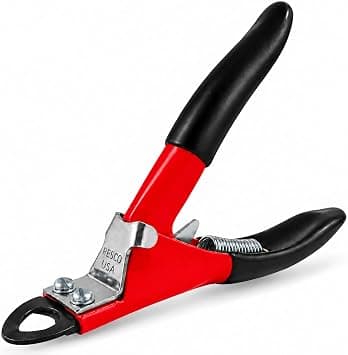
Resco Professional Guillotine Cat Nail Clippers with Grips, Red
The guillotine to buy, and the right first clipper for an owner who is nervous about the quick. Resco sizes this one for cats and pets under 10 pounds, makes it in the USA, and builds it around a patented replaceable blade, which matters because a dull guillotine blade crushes a claw instead of cutting it. It costs more than the scissors here and it earns it if you will own it for a decade.
We may earn a commission on this link. It never changes the ranking.
- Type
- Guillotine
- Sized for
- Cats and pets under 10 lb, per Resco
- Blade
- Replaceable
- Made in
- USA
- Warranty
- Limited lifetime, per Resco
What works
- The ring acts as a repeatable length reference while you learn
- Replaceable blade keeps the cut clean for years
- Grips give a steadier squeeze than bare steel handles
- The style WSU calls easiest to use in cats
What to know
- The claw is hidden inside the head at the moment of the cut
- Fed in from the wrong side, the blade moves toward the quick
- Not the right tool for dewclaws, where WSU prefers scissors
- Most expensive of the four by a wide margin
$20.00
Price checked Oct 5, 2026
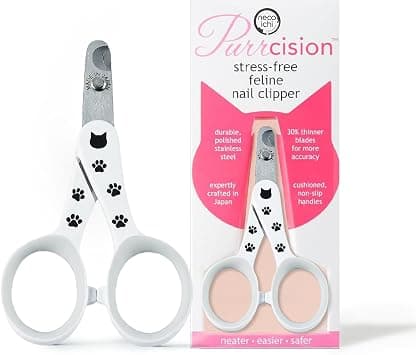
Necoichi Purrcision Stainless Steel Cat Nail Clipper, Made in Japan (White)
The scissor clipper for owners who want to see exactly what they are cutting. Necoichi makes it from Seki City stainless steel in Japan, and the selling point is a thin, sharp blade profile that leaves the quick visible right up to the cut, paired with cushioned, non-slip handles. On a light-clawed cat that will sit for a few claws at a time, this is the most precise tool here.
We may earn a commission on this link. It never changes the ranking.
- Type
- Scissor-style
- Blade
- Thin stainless steel from Seki City, Japan
- Handles
- Cushioned, non-slip
- Made in
- Japan
What works
- Thin blades keep the pink quick in view
- Shears the claw rather than squeezing it
- Small head angles easily for a top-to-bottom cut
- Works for dewclaws as well as the weight-bearing claws
What to know
- No guard or length stop, so judgement is entirely yours
- Twice the price of a basic scissor clipper
- Dense dark claws still need small, cautious cuts
$11.99
Price checked Oct 5, 2026
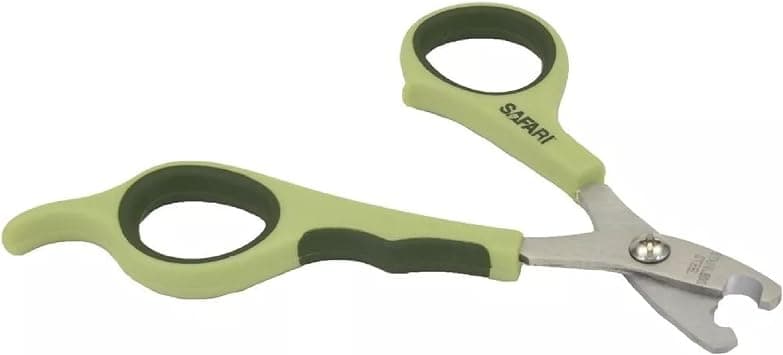
Coastal Pet Safari Cat Deluxe Nail Trimmer
The fix for the most common hand problem with cat clippers. Coastal builds the Cat Deluxe around stainless steel cutters with an over-molded handle, a large finger hole and a non-slip finger rest, at 5 inches long by 2.25 inches wide. That grip is what keeps the blades steady when the cat shifts, and at this price it is the sensible default for most households.
We may earn a commission on this link. It never changes the ranking.
- Type
- Scissor-style, curved
- Cutters
- Stainless steel
- Handle
- Over-molded, large finger hole, non-slip finger rest
- Size
- 5 in L x 2.25 in W
What works
- Large finger hole suits hands that small loops do not
- Non-slip finger rest steadies the cut
- Curved blades cradle a narrow claw
- Inexpensive enough to keep one where the cat is calmest
What to know
- Wider tool overall, at 2.25 inches across
- No length guard
- Larger handle is more than a small-handed owner needs
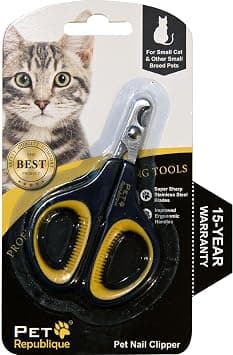
$6.99
Price checked Oct 5, 2026
Pet Republique Cat Nail Clippers, Stainless Steel (Black+Yellow)
The cheapest clipper worth owning. A small stainless steel scissor clipper sized for cats and kittens, and the listing price sits at or below the brand's own posted list prices for its cat clippers. Buy it as the spare that lives in the drawer next to the treats, or as the first clipper for a kitten whose claws are small and soft.
We may earn a commission on this link. It never changes the ranking.
- Type
- Scissor-style
- Blades
- Stainless steel
- Sized for
- Cats, kittens and small animals
What works
- Lowest price of the four by a distance
- Sized for cats and kittens rather than dogs
- Cheap enough to keep a spare where the cat is calmest
What to know
- No replaceable blade, so it is replaced whole when it dulls
- Less precise sightline than the thin-bladed Necoichi
| Clipper | Mechanism | Best for | Main limit | Price |
|---|---|---|---|---|
| Resco Guillotine, Cat | Guillotine | Learning the cut, cats under 10 lb | Claw hidden at the cut | $29.99 |
| Necoichi Purrcision | Scissor-style | Seeing the quick on pale claws | No length guard | $20.00 |
| Safari Cat Deluxe | Scissor-style | Large hands, steady grip | Wider tool overall | $11.99 |
| Pet Republique | Scissor-style | Kittens, a spare pair | No replaceable blade | $6.99 |
How to choose between them
If you have never trimmed a cat's claws and the quick worries you, start with the Resco guillotine. The ring keeps every cut roughly the same length, and that consistency is worth more to a beginner than a perfect sightline.
If the cat has pale claws and you want to see the quick before you commit, the Necoichi is the better tool. On white or translucent claws the pink wedge is visible, and thin blades keep it in view until the moment of the cut.
If the clippers you already own feel like they are slipping in your hand, the problem is the grip, and the Safari Cat Deluxe is the cheapest way to solve it.
And if the cat has dewclaws, own a scissor clipper even if your main tool is a guillotine. WSU names the scissors type as best for dewclaws, which sit on the inside of the front leg and can grow into the skin if nobody trims them.
Making any clipper work
Handle the cat, not the claw. VCA's guidance is that less restraint is more, that many cats resent being held more than the trim itself, and that a cat on a lap or a cat bed, petted by a helper, often accepts more than a cat pinned on a table. If your cat fights restraint, VCA's advice is to stop and ask your vet for help or a demonstration rather than escalate. WSU also recommends owners learn the technique from a veterinarian or veterinary technician before doing it at home.
Extend the claw by pressing the toe, not by pulling the claw. VCA's method is to press the middle paw pad between thumb and forefinger, which pushes the claws out so you can see what you are cutting. The full sequence, and why a cat's retractable claw makes this a different job from a dog's nail, is in the guide to trimming a cat's nails.
Do not aim for all eighteen. VCA says that a cat that loathes nail trims should not have a goal of every claw in one sitting, and that a treat after each paw builds a better association than one big reward at the end. Two claws today and two tomorrow is a trim that still works in five years.
Keep styptic powder within reach before you start. VCA says to apply a small amount to the claw tip if you nick the quick, and to use flour or cornstarch if you have no styptic powder. WSU notes that without styptic powder the bleeding may take about 5 minutes to stop, which is a long time to hold a cat that has just learned the clipper hurts.
Trims and scratching posts work together, and where the cat tree stands decides whether the post gets used at all. The same short, low-stakes handling that keeps a long-haired coat free of mats in a cat's coat is what makes a paw easy to hold.
Questions people actually ask
Is a guillotine or scissor clipper better for a cat?
Both are safe for cats according to VCA. Washington State University calls the guillotine type the easiest to use in cats and recommends scissors for dewclaws. A guillotine suits a beginner who wants a consistent length, and a scissor clipper suits an owner who wants to see the claw and the quick right up to the cut.
Can I use human nail clippers on my cat?
VCA says human nail clippers can be used on cats, but recommends keeping separate clippers for your cat and for people to reduce the risk of spreading infection. A small cat-specific scissor clipper costs little and is shaped for a narrow, curved claw.
How far from the quick should I cut?
Washington State University puts it at about 2 millimetres in front of the quick. On a dark claw where you cannot see the quick, VCA advises cutting where the claw curves or hooks downward and making several small cuts rather than one large one.
What do I do if I cut the quick?
Apply a small amount of styptic powder to the end of the claw, as VCA advises, or flour or cornstarch if that is all you have. Then end the session on something pleasant. If the bleeding does not stop with powder and pressure, call your vet.
Which way round does a guillotine clipper go?
Washington State University's instruction is to place the tip of the claw in the stationary ring with the clipper perpendicular to the claw, keep the cutting blade on your side rather than the cat's, and cut from top to bottom.
Sources
- VCA Animal Hospitals: How to Trim a Cat's Nails
- Washington State University Veterinary Teaching Hospital: How to clip a cat's nails
- Resco: Deluxe Resco Guillotine Nail Clipper, Red, Cat
- Coastal Pet: Safari Cat Deluxe Nail Trimmer
- Pet Republique: products and list prices
- Totally Meow: Necoichi Purrcision Feline Nail Clippers product description
As an Amazon Associate we earn from qualifying purchases. We earn a commission on some links, at no extra cost to you. It never changes which products we recommend or the order they appear in. Full disclosure

Who wrote this
Marin Okafor
Editor, dog gear and nutrition labels
Marin Okafor edits PetGearSearch and writes the dog side of it: food, beds, crates, carriers, grooming tools, and the pet insurance policies that pay for the rest. The ingredient panel and the AAFCO statement get read before a single review does, because that back-of-bag paragraph is where two apparently identical foods stop being identical.
The standard
How this guide was built
- The full product specification, ingredient panel or material spec, read end to end rather than summarised from a retail listing.
- The veterinary and regulatory guidance that applies to the category, cited by name and linked — AAFCO nutrient profiles, WSAVA manufacturer guidelines, the VOHC accepted-product list.
- Aggregated owner reviews at volume across retailers, read for the pattern rather than the anecdote, with deliberate attention to the one-star reports where the failure modes live.
- Every price checked against the live listing on the date printed beside it.