Airline Approved: What That Label Actually Has to Mean
No agency certifies a pet carrier as airline approved. Three separate rulebooks decide whether yours flies, and two of them publish exact numbers.
By Marin Okafor, editor, dog gear and nutrition labels
Published Sep 22, 2026 · 13 min read
- Crates & Carriers
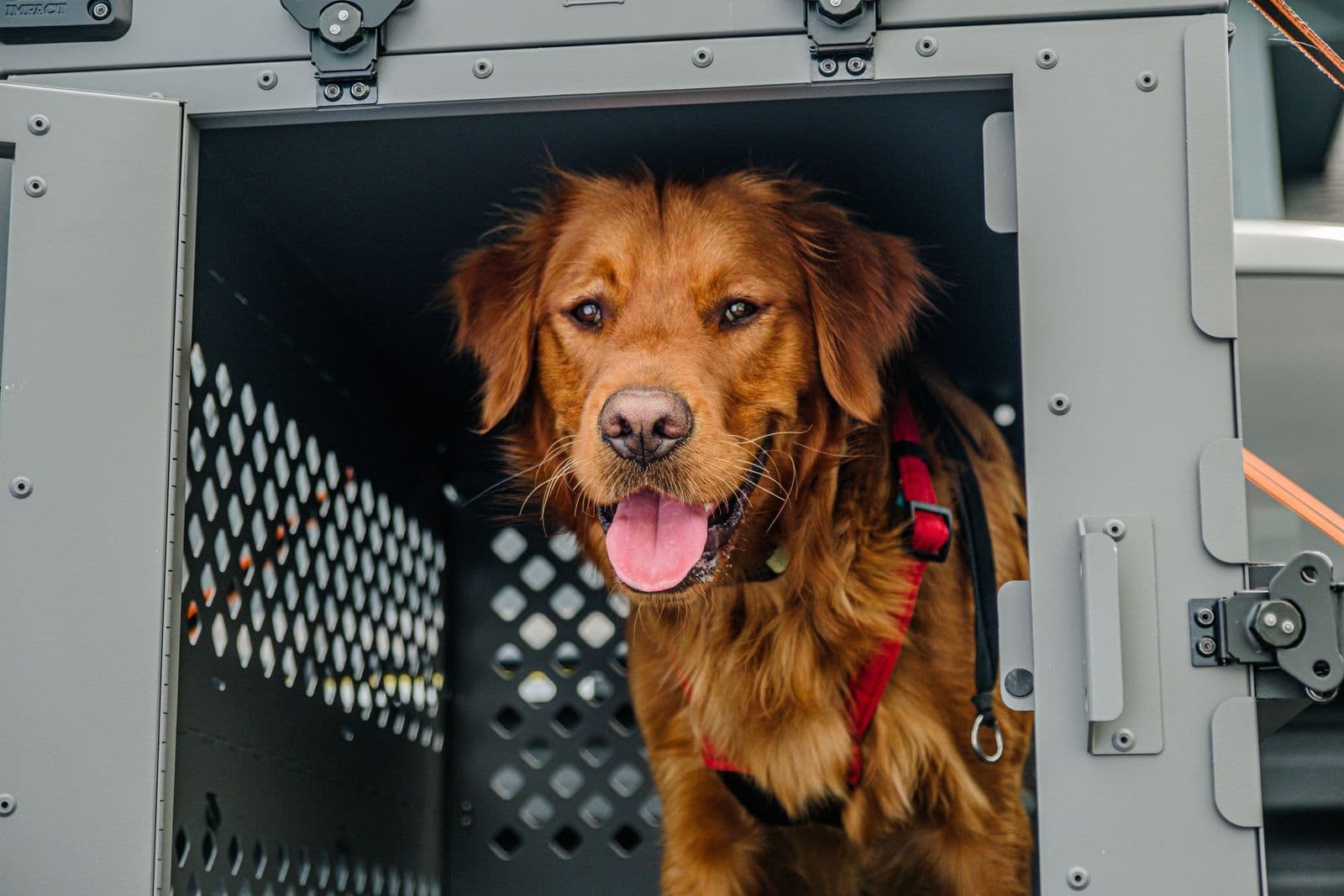
In this guide
- The three rulebooks, and which one is yours
- What the federal rules require of the box itself
- The temperature limits that ground more pets than carriers do
- The sizing formula nobody prints on the box
- In the cabin, it is the airline's rulebook
- Emotional support animals are not service animals
- What this means when you are buying
- Sources
No agency certifies a pet carrier as airline approved. There is no scheme, no register, no seal and no inspector. A manufacturer prints the phrase because nothing stops it, and two carriers sitting side by side on the same shelf wearing the same three words can differ by enough to get one of them turned away at the counter.
What does exist is three separate rulebooks, and the useful thing about all three is that they publish actual figures where the packaging offers adjectives. A carrier either has ventilation openings covering 14 percent of its combined wall area or it does not. Knowing which of the three applies to your flight is most of the work, because the requirements they impose are genuinely different, and the one nearly everybody reads about online is the one least likely to govern the trip.
The three rulebooks, and which one is yours
If the animal travels in the hold in United States commerce, the Animal Welfare Act regulations at 9 CFR Part 3 apply, and they carry the force of law. If the animal travels on almost any international carrier, IATA's Live Animals Regulations and its Container Requirement 1 apply, because airlines adopt them as their acceptance standard. If the animal travels in the cabin, the binding document is the airline's own policy for the specific aircraft, with CR1 sitting underneath it as the floor.
Most owners are flying a small dog or a cat in the cabin, which means the third rulebook governs and the federal cargo standards mostly do not. That is worth knowing before spending three hundred dollars on a rigid kennel built to a standard the flight never invokes.
What the federal rules require of the box itself
The construction standards at 9 CFR 3.15 are the most specific published requirements in this category, and they are where the phrase "airline approved" gets whatever meaning it has. Ventilation is the part with real numbers, and the regulation offers three ways to satisfy it.
| Vented walls | Opening area per wall | Combined minimum |
|---|---|---|
| Two opposing walls | At least 16% of each wall's surface area | 14% of all walls combined |
| Three walls | 8% on each of two opposing walls, 50% on the third | 14% of all walls combined |
| All four walls | At least 8% of each wall's surface area | 14% of all walls combined |
The rest of the construction list is shorter than people expect and easy to check by eye. Projecting rims on the outside of every vented wall, large enough to hold a minimum of 0.75 inches of air circulation space between the carrier and whatever it is pushed up against. The words "Live Animals" in letters at least one inch high, on the top and on at least one side, with arrows showing the upright position. Handles or handholds that let the box be lifted without tilting it and without the handler touching the animal. A solid leak-proof bottom, or a removable leak-proof tray under a slatted or mesh floor whose gaps are too small for a paw. No sharp edges or protrusions inside, nontoxic materials throughout, and a door that allows the animal to be removed quickly in an emergency.
The space standard is written as behaviour rather than inches: the animal must have room to turn about normally while standing, to stand and sit erect, and to lie in a natural position. A carrier that fails any one of those four is non-compliant regardless of what its label claims, and that is the test a check-in agent applies by looking at the animal inside it.
The temperature limits that ground more pets than carriers do
This is the part that catches people, because it has nothing to do with the equipment and everything to do with the date on the ticket. In an airline's animal holding area the ambient temperature must not fall below 45°F or rise above 85°F for more than four consecutive hours while animals are present. While the animal is actually being moved between the terminal and the aircraft, the window narrows sharply: no more than 45 minutes above 85°F, and no more than 45 minutes below 45°F.
The cold limit has an exemption and the heat limit does not. A certificate of acclimation to lower temperatures, signed by a veterinarian and dated no more than 10 days before the animal is handed over, lets a carrier accept a shipment it would otherwise refuse. Nothing equivalent exists for heat, which is why summer cargo embargoes on particular routes cannot be cleared with paperwork at all.
Three more federal timings are worth writing on the booking confirmation. An airline may not accept the animal more than four hours before scheduled departure, extendable to six by agreement. Food and water must be offered within the four hours before handover, with a signed certification of the date and time attached to the outside of the carrier. In transit, animals 16 weeks and older must be offered food at least every 24 hours and those under 16 weeks at least every 12, with water at least every 12 hours for both.
The sizing formula nobody prints on the box
IATA publishes an arithmetic method for container dimensions, and it is far more useful than a size chart because it is indexed to your animal rather than to a breed average. Take four measurements: A, nose to the base of the tail. B, ground to the elbow joint. C, width across the shoulders or the widest point, whichever is greater. D, floor to the top of the head or the ear tip, whichever is higher.
The minimum internal dimensions then fall out directly. Length equals A plus B. Width equals C multiplied by two. Height equals D plus the height of the bedding you intend to use, which is the term most people forget and the one that turns a just-about-adequate crate into a non-compliant one. Snub-nosed breeds require a container 10 percent larger than the formula gives.
Those are internal dimensions, so a crate advertised by its external footprint needs the wall thickness subtracted before the comparison means anything. The same measuring discipline that decides what size crate a dog needs at home applies here with less forgiveness, because at home a crate that is slightly too small is a comfort problem and at the counter it is a refusal.
IATA also caps sharing. Two compatible adult animals of similar size, each no heavier than 14 kg, may travel in one container. Anything over 14 kg travels alone. Puppies and kittens may share only if they are from the same litter, no older than six months and no heavier than 14 kg each, to a maximum of three, and many national rules are stricter still.
In the cabin, it is the airline's rulebook
IATA issued its first edition of operational guidelines for in-cabin pet transport on 15 July 2026, and what it describes is a process, start to finish, in which the container is only one checkpoint. Cats and dogs may travel in the cabin subject to airline policy provided they meet CR1, and the container must fit entirely under the seat in front without compromising its own ventilation. Under-seat space varies by aircraft type within a single airline's fleet, which is the real reason a carrier that flew out fine can be refused on the return leg.
Booking is its own hurdle. Reservations are generally required 48 to 72 hours before departure, pet-in-cabin is registered against a specific code that many third-party booking sites and metasearch tools do not support, and the guidance is explicit that passengers in that position should book directly with the airline. Check-in staff verify the container against CR1, confirm the documentation for the complete itinerary including connections, and assess the animal, and the guidance states plainly that failure to meet the requirements must result in denied boarding.
Two practical details rarely make it into the marketing copy. At security screening, some jurisdictions require the animal to come out of the container so that animal and container can be screened separately, which is a moment worth rehearsing with a cat that has never been handled in a crowd. And onboard, the animal stays inside the container for the entire flight, stowed during taxi, takeoff, landing and turbulence. A carrier the animal will not settle in is therefore a welfare problem for several hours rather than for the few minutes it takes to board, which is the argument for starting carrier training weeks before the flight rather than the night before.
Sedation is discouraged unless a veterinarian has prescribed it, and where it has been used the documentation has to travel with the animal. An animal that presents as excessively lethargic or unresponsive at check-in without that paperwork can be refused. This is a conversation to have with your own vet well before departure, not a decision to make at the airport.
Emotional support animals are not service animals
The federal definition is unambiguous and it has caught a lot of people out since it changed. Under 14 CFR 382.3, a service animal is a dog, regardless of breed or type, individually trained to do work or perform tasks for a person with a disability. The same section states that animal species other than dogs, emotional support animals, comfort animals, companionship animals, and service animals in training are not service animals for the purposes of that part.
The practical consequence is that an emotional support animal travels as a pet, under the pet rules, at the pet fare, in a compliant container. Arriving at the gate expecting otherwise is the single most common way a booking falls apart.
What this means when you are buying
Buy for the rulebook the flight actually invokes. For a cabin trip, the constraint is under-seat clearance on the specific aircraft, so the airline's published dimensions for that fleet outrank every claim on the packaging, and a soft-sided carrier that compresses slightly is usually the better bet. For the hold, work the IATA formula from your own four measurements, add the bedding, add 10 percent if the animal is snub-nosed, then check the ventilation pattern and the markings against the list above.
Treat an unreferenced "airline approved" sticker as worth nothing, and a specific claim as worth checking. A manufacturer that states which standard the container is built to has said something falsifiable, which is the same distinction that separates a genuinely certified cat carrier from one that merely says so. The crates worth buying for a dog divide along the same line, and the rigid plastic kennels in that category are the ones actually built against this list.
One last thing that surprises owners: none of this covers the drive to the airport, where the risks are different and better documented. Restraining a pet in a car is a separate decision with a separate evidence base, and a crate that satisfies every line of 9 CFR 3.15 may still be the wrong thing to put loose in a boot.
Questions people actually ask
Is there such a thing as an airline approved pet carrier?
Not as a certification. No agency or standards body issues an airline approved seal, and the phrase is unregulated marketing copy. What exists is the federal construction standard at 9 CFR 3.15 for animals flying as cargo in US commerce, IATA's Container Requirement 1 which airlines adopt as their acceptance standard, and each airline's own policy for the specific aircraft. Check the container against whichever of those governs your flight.
How do I work out what size crate my pet needs to fly?
Use IATA's formula rather than a breed chart. Measure A, nose to base of tail, B, ground to elbow, C, width across the shoulders, and D, floor to the top of the head or ear tip, whichever is higher. Minimum internal length is A plus B, width is C times two, and height is D plus the depth of the bedding. Snub-nosed breeds need a container 10 percent larger.
How much ventilation does a travel crate legally need?
Under 9 CFR 3.15(c) the combined openings must cover at least 14 percent of the total wall area, reached one of three ways: 16 percent on two opposing walls, or 8 percent on two opposing walls plus 50 percent on a third, or 8 percent on all four. At least a third of that area must sit on the upper half of the enclosure, and exterior rims must hold a 0.75 inch air gap so the vents cannot be blocked.
Can my emotional support animal fly in the cabin for free?
No. 14 CFR 382.3 defines a service animal as a dog individually trained to do work or perform tasks for a person with a disability, and states explicitly that emotional support animals, comfort animals, companionship animals and service animals in training are not service animals under that part. An emotional support animal travels as a pet, at the pet fare, in a compliant container.
Why do airlines refuse pets in summer?
Because the temperature rules leave no room. Animal holding areas must stay between 45°F and 85°F, and while an animal is being moved to or from the aircraft it may spend no more than 45 minutes above 85°F. The cold limit can be waived with a veterinary certificate of acclimation dated within 10 days, but there is no equivalent waiver for heat, so hot routes get embargoed instead.
Should I sedate my pet for a flight?
Not on your own initiative. IATA's in-cabin guidance discourages sedation unless a veterinarian has prescribed it, and requires the documentation to travel with the animal. An animal presenting as excessively lethargic or unresponsive at check-in without that paperwork can be refused boarding. Raise it with your vet well before the departure date.
Sources
- eCFR: 9 CFR Part 3 Subpart A, humane handling and transportation standards for dogs and cats
- eCFR: 14 CFR Part 382, nondiscrimination on the basis of disability in air travel
- IATA Traveler's Pet Corner, container guidance and dimension formula
- IATA Operational Guidelines for In-Cabin Pet Transport, Edition 1, 15 July 2026
- Center for Pet Safety: crash-test research on carriers, crates and travel restraints
As an Amazon Associate we earn from qualifying purchases. We earn a commission on some links, at no extra cost to you. It never changes which products we recommend or the order they appear in. Full disclosure

Who wrote this
Marin Okafor
Editor, dog gear and nutrition labels
Marin Okafor edits PetGearSearch and writes the dog side of it: food, beds, crates, carriers, grooming tools, and the pet insurance policies that pay for the rest. The ingredient panel and the AAFCO statement get read before a single review does, because that back-of-bag paragraph is where two apparently identical foods stop being identical.
The standard
How this guide was built
- The full product specification, ingredient panel or material spec, read end to end rather than summarised from a retail listing.
- The veterinary and regulatory guidance that applies to the category, cited by name and linked — AAFCO nutrient profiles, WSAVA manufacturer guidelines, the VOHC accepted-product list.
- Aggregated owner reviews at volume across retailers, read for the pattern rather than the anecdote, with deliberate attention to the one-star reports where the failure modes live.
- Every price checked against the live listing on the date printed beside it.