How Often to Bathe a Dog, and Why Human Shampoo Is the Wrong Bottle
Most healthy dogs need a bath every 4 to 12 weeks. What sets the interval, why human shampoo is the wrong product, and the rinse most people cut short.
By Marin Okafor, editor, dog gear and nutrition labels
Published Sep 26, 2026 · 12 min read
- Grooming
In this guide
The honest answer to how often a dog needs a bath is a range, and the range is wider than most owners expect. The dermatology service at Virginia Tech's Veterinary Teaching Hospital puts it plainly: many healthy dogs do well with baths every 4 to 12 weeks, and where a dog falls inside that window depends on its coat and how it lives. A smooth-coated dog that spends its days on a sofa sits at the long end. A water-loving retriever that rolls in whatever the tide left behind sits at the short end, and nobody needs a study to tell them so.
What matters more than the number is how the bath is done. The same Virginia Tech page, written with the hospital's dermatology specialist Ivan Ravera, makes the point that a routine bath can turn into a veterinary visit when it goes wrong. The failures it lists are ordinary ones: a harsh product, rough scrubbing, shampoo left in the coat, and a dog put away damp. None of them involve bathing too often. All of them involve bathing badly.
What decides where your dog sits in the 4 to 12 week range
Coat type. A short, smooth coat sheds dirt easily and dries quickly, so it tolerates long gaps between baths. A dense double coat holds dirt and loose undercoat close to the skin, and its real maintenance happens with a rake and a comb between baths. A bath and a thorough blow-dry at the start of each seasonal shed shifts an enormous volume of dead undercoat, which is the whole case for managing a double coat instead of shaving it. Long, fine coats that tangle sit in between, and they carry an extra rule covered further down.
Lifestyle. Swimming, mud, farm work and long off-lead hikes all shorten the interval. A dog that gets wet most days and dries in a crate or a car picks up more odour and more debris than one that mostly lives indoors.
Smell and feel, read honestly. A coat that feels greasy at the roots, leaves a film on your hand, or smells before the usual interval is up is worth noticing. Occasionally that is just a dog that found something to roll in. When it keeps happening, it is information about the skin rather than a reason to bathe more, and that is where the section on recurring problems applies.
Skin that is already inflamed. This is the one case where the answer is no bath at all until a vet has looked. Virginia Tech is specific: skip the bath and call your vet if your dog has inflamed skin, open sores, or seems uncomfortable when touched, because bathing irritated skin with the wrong product can make inflammation worse or spread infection.
Why human shampoo is the wrong bottle
The short reason, from the Virginia Tech dermatology page, is that dog skin is less acidic than human skin, and products formulated for people disrupt that balance in a way that favours the bacteria you least want on a dog.
The research behind that is more interesting than the slogan. Canine skin pH is not one number. A comparative review of cutaneous pH by Matousek and Campbell at the University of Illinois set out how much it varies between species, between individuals of the same species, and across different sites on the same animal, and it described the jobs that skin acidity does: selecting and maintaining the normal skin microbiota, and helping protect against infection.
Later measurements bear out how wide that variation is in dogs. A 2022 Belgian study measured intact skin in 77 client-owned dogs at the ear flaps, armpits and groin. Adult dogs ranged from pH 4.40 to 8.18, puppies under 12 weeks ran significantly lower at 3.97 to 5.70, and the groin read lower than the ear flaps. An earlier study that mapped 14 body regions in healthy Beagles found skin pH was usually alkaline, highest on the lower back and tail.
Put together, the practical reading is this. A dog's skin generally sits on the less acidic side of human skin, it varies across the body, and a product tuned for the human side of that line is tuned for the wrong animal. A pet shampoo is the default for routine baths, full stop. If a vet has prescribed a medicated shampoo, that product replaces the routine one for as long as the vet says, and its instructions win over anything on this page.
Baby shampoo is still a human shampoo. It is formulated to be gentle on a human infant's eyes and skin, which is a different specification from a dog's skin, and the Virginia Tech advice does not carve out an exception for it. Buy the dog product.
The bath itself, step by step
Most of what goes wrong happens either before the water is turned on or after it is turned off, so the sequence matters.
Brush first, and deal with tangles a day or two ahead. Virginia Tech's guidance is to brush thoroughly before wetting, because loose hair and mats trap water and shampoo against the skin, and to do any heavy detangling a day or two before the bath rather than immediately beforehand. Gentle strokes only: rough brushing leaves small scrapes that sting once shampoo reaches them. A matted dog is a special case, because water tightens a felted mat. Get the mats out before the bath every time. For a brush that reaches the skin on your dog's coat type, the shedding-season brush roundup sorts them by coat.
Check the bottle. This is the step almost nobody takes. Old shampoo loses effectiveness and can harbour bacteria, particularly if water has got into it. Virginia Tech's rule is to replace shampoo that is more than a year old or has been stored somewhere damp.
Dilute on the day, and never keep the leftover. Diluting shampoo makes it easier to work through a thick coat, and it is also the single biggest contamination risk in the whole routine. A 2022 study cultured 117 bottles of non-medicated dog grooming products from grooming salons and private owners and isolated Pseudomonas aeruginosa from 14 of them, just under 12 percent. Diluted products were contaminated far more often than undiluted ones, with an odds ratio of 15.5. That matters because P. aeruginosa is the bacterium most commonly isolated from post-grooming furunculosis, a deep and painful skin infection that follows a bath or a groom. Mix only what one bath needs, use it, and clean and dry the dilution bottle afterwards.
Lukewarm water, fingertips, neck to tail. Wet the coat through to the skin, then work the shampoo in with your fingertips in small circles, starting at the neck and moving back. Keep shampoo out of the eyes, ears and nose. The face is better wiped with a damp cloth than lathered.
Rinse for longer than feels necessary. This is the step people cut short, and it is the one Virginia Tech is firmest about: shampoo left on the skin causes irritation that makes it easier for bacteria to take hold. Run your hands through the coat as you rinse and keep going while you can still feel slickness or see foam. The places residue hides are the armpits, the groin, under the tail, between the toes and behind the ears. On a double coat, part the hair and check that the water is reaching the skin, because the outer coat sheds water by design.
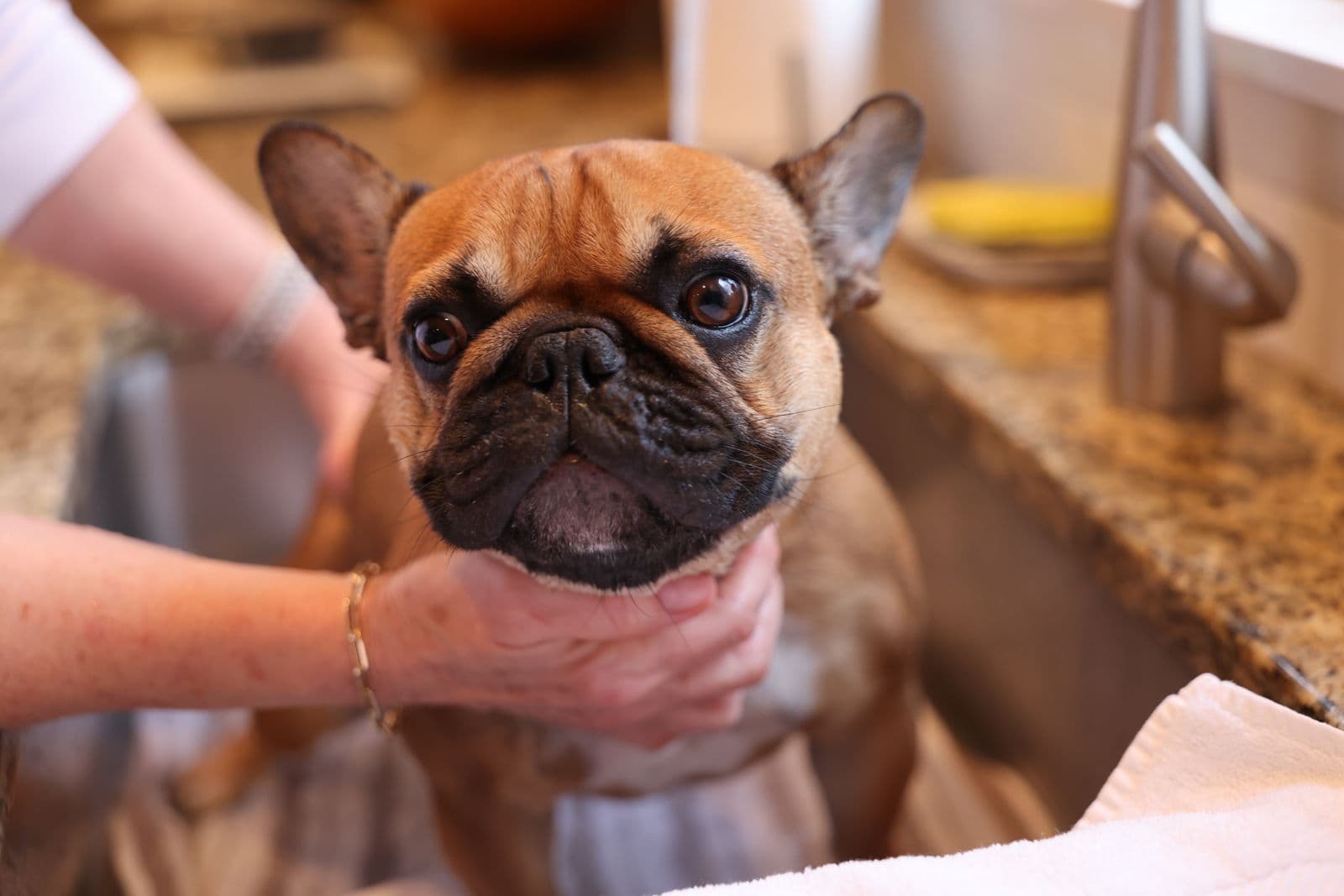
Dry completely, especially the hidden places. Press towels into the coat rather than rubbing, which tangles long hair and roughens the skin. A blow dryer is fine on a cool or low setting, kept moving, since heat held in one spot can burn. The dryer earns its place on a double coat, where a towel alone leaves the undercoat wet for hours. Skin folds and the spaces between the toes are where trapped moisture causes trouble, and Virginia Tech notes that in dogs with underlying allergies, prolonged damp fur can lead to yeast infections in exactly those spots. On a flat-faced breed with facial folds, dry the folds by hand.
Do the nails while you are there. A clean, relaxed dog on a towel is a good moment for a nail trim, and short nails matter on a slippery tub floor too.
Is frequent bathing bad for a dog's skin?
This is where the old advice has shifted. The worry used to be that frequent bathing strips a dog's skin, so the safest bath was a rare one. The evidence does not support treating frequency as the danger on its own terms.
Start with how the skin recovers. Ravera, quoted on the Virginia Tech page, notes that in healthy dogs, research shows minor damage to the skin barrier recovers by more than half within 24 hours and is fully restored within about 72 hours. The damage he warns about comes from harsh products, rough handling and residue, which is why the page frames the issue as how you bathe rather than how often.
Then look at the dogs whose skin is most fragile. The International Task Force on Canine Atopic Dermatitis, in its 2010 clinical practice guidelines, recommends treating acute flares with a combination of nonirritating baths and topical medication, and improving skin and coat hygiene in chronic cases by bathing with nonirritating shampoos. Bathing sits inside the treatment plan for allergic dogs, and how often is a decision their vet makes. A 2024 randomised study of 17 atopic dogs bathed once a week for four weeks found no significant difference in skin barrier measurements between a shampoo group and a fine-bubble bathing group, although water loss through the skin crept up slightly in the shampoo group.
The conclusion for a healthy dog is straightforward. Bathe when the coat and lifestyle call for it, somewhere in the 4 to 12 week window, with a gentle pet shampoo, a full rinse and a full dry. There is no reward for stretching the interval to prove a point, and no reason to bathe weekly a dog whose skin is fine.
When bathing keeps not fixing the problem
A dog that smells again three days after a bath, scratches, has recurring ear trouble, or develops redness or bumps after baths is not a bathing problem. Ravera is blunt about this on the Virginia Tech page: in his view there is no such thing as sensitive skin in pets, and when a dog keeps getting repeat ear infections, repeat skin infections or repeat itching, there is an underlying disease causing it, most often allergies. That is the point to stop changing shampoos and book a vet appointment, and to ask whether a referral to a veterinary dermatologist makes sense. A shampoo swap can hide the signal for a few weeks while the cause carries on underneath.
For cats, the same page is short: cats generally do not need baths unless a condition stops them grooming themselves. The coat problems that do come up in cats are covered in our guide to mats in a cat's coat.
Questions people actually ask
How often should a dog be bathed?
Many healthy dogs do well with a bath every 4 to 12 weeks, according to the dermatology service at Virginia Tech's Veterinary Teaching Hospital. Coat type and lifestyle decide where a dog sits in that range: smooth-coated house dogs at the long end, swimmers and muddy working dogs at the short end.
Can human shampoo be used on a dog?
It is the wrong product for routine baths. Dog skin is generally less acidic than human skin and varies more across the body, and products made for people disrupt that balance. Baby shampoo is still a human shampoo. Use a shampoo made for dogs, or the medicated one a vet prescribed.
Should a matted dog be bathed before the mats come out?
No. Water tightens a felted mat and traps moisture against the skin underneath it. Brush and detangle a day or two before the bath, and see our guide to removing mats from a dog's coat for what combs out and what needs clippers.
Is it safe to dilute dog shampoo?
Yes, if it is mixed on the day and the leftover is thrown away. A 2022 study of 117 dog grooming products found Pseudomonas aeruginosa in about 12 percent of bottles, and diluted products were contaminated far more often than undiluted ones. Clean and dry the dilution bottle after each bath.
Does frequent bathing damage a dog's skin?
Not in itself. Harsh products, rough scrubbing and shampoo left in the coat are what damage the skin barrier, and in healthy dogs minor barrier damage largely recovers within about 72 hours. Dogs with allergic skin disease are often bathed more often as part of treatment, on a schedule set by their vet.
Sources
- Virginia Tech Veterinary Teaching Hospital: Safe bathing practices, protecting your pet's skin
- Matousek JL, Campbell KL. A comparative review of cutaneous pH. Veterinary Dermatology, 2002, 13(6), 293-300
- Schlake A et al. Influence of age, sex, body condition score, rectal temperature, anatomical location and hair on skin pH in dogs. Veterinary Dermatology, 2022, 33(1), 3-e2
- Oh WS, Oh TH. Mapping of the dog skin based on biophysical measurements. Veterinary Dermatology, 2010, 21(4), 367-372
- Perry E et al. Pseudomonas aeruginosa isolation from dog grooming products used by private owners or by professional pet grooming salons. Veterinary Dermatology, 2022, 33(4), 316-e73
- Olivry T et al. Treatment of canine atopic dermatitis: 2010 clinical practice guidelines from the International Task Force on Canine Atopic Dermatitis. Veterinary Dermatology, 2010, 21(3), 233-248
- Taguchi N et al. Preliminary evaluation of a commercial shampoo and fine bubble bathing in the treatment of canine atopic dermatitis. Veterinary Dermatology, 2024, 35(4), 400-407
As an Amazon Associate we earn from qualifying purchases. We earn a commission on some links, at no extra cost to you. It never changes which products we recommend or the order they appear in. Full disclosure

Who wrote this
Marin Okafor
Editor, dog gear and nutrition labels
Marin Okafor edits PetGearSearch and writes the dog side of it: food, beds, crates, carriers, grooming tools, and the pet insurance policies that pay for the rest. The ingredient panel and the AAFCO statement get read before a single review does, because that back-of-bag paragraph is where two apparently identical foods stop being identical.
The standard
How this guide was built
- The full product specification, ingredient panel or material spec, read end to end rather than summarised from a retail listing.
- The veterinary and regulatory guidance that applies to the category, cited by name and linked — AAFCO nutrient profiles, WSAVA manufacturer guidelines, the VOHC accepted-product list.
- Aggregated owner reviews at volume across retailers, read for the pattern rather than the anecdote, with deliberate attention to the one-star reports where the failure modes live.
- Every price checked against the live listing on the date printed beside it.