Best Dog Ramps for Cars and Beds
Four ramps judged on the only number that decides whether one helps: the angle it makes against the height it has to bridge. Measure the rise before you buy.
By Marin Okafor, editor, dog gear and nutrition labels
Published Sep 21, 2026 · 13 min read
- Beds & Furniture
- 4 products compared
In this guide
Cornell's Riney Canine Health Center puts "use of non-slip rugs and ramps to get on beds, couches or cars" on the same short list of lifestyle changes as weight control and low-impact exercise. That endorses the category and no particular product, because a ramp is not a single thing. It is a plank at an angle, and the angle is set by two numbers: the ramp's length, and the height it has to reach.
Almost every ramp is marketed on the first number and almost none on the second, which is how a dog with sore hips ends up climbing a 30-degree incline bought specifically to spare it. The published kinematics are blunt about this. A University of Tennessee group compared forelimb joint movement in healthy dogs ascending stairs against ascending a purpose-built ramp, and found ramp ascent produced significantly greater range of motion than stairs at the shoulder, the elbow and the carpus. In rehabilitation that is the point. For a dog with osteoarthritis it is the opposite of what the owner was buying.
The counterweight comes from the descent side. A second kinematic study put eight dogs down a set of stairs and down a solid plank laid over those same stairs at a matched 35-degree slope, and found descending the stairs significantly increased shoulder and elbow range of motion against flat trotting while the ramp did not.
Put those results together and the rule falls out. A ramp is not automatically gentler than a jump or a step. It is gentler when it is long enough relative to the rise, and the moment it is not, you have bought a steeper staircase with no footholds.
Measure the rise first, then buy the length
Before reading a single listing, measure the height you need to bridge, from the ground to the lip the dog has to clear. For most cars that is 18 to 22 inches at the boot sill, for a mid-size SUV 26 to 30 inches, for a full-size pickup bed 32 to 36 inches, and for a bed frame with a mattress on it 24 to 28 inches.
Then work out the angle. Rise divided by ramp length, run through an inverse sine, gives it in degrees, and that arithmetic matters more than any feature on the box. A 62-inch ramp against a 20-inch car sill sits at about 19 degrees. The same ramp against a 28-inch SUV sill is about 27 degrees, within a few degrees of the plank in the descent study and a long way from gentle. A 72-inch ramp at that sill drops to about 23 degrees, and an 87-inch ramp against a 34-inch truck bed is back to about 23.
Length buys angle, and no amount of surface texture or side railing substitutes for it. Roughly 20 degrees is the number to aim at for a dog with a diagnosed joint condition, and anything past about 25 degrees is a compromise you are making knowingly.
Three other specifications decide whether the ramp survives contact with a real dog:
The weight rating needs real margin above the dog. A ramp rated at exactly the dog's weight flexes underfoot on the first crossing, and a surface that moves is what makes a nervous, painful dog refuse a second attempt. The gap between a 150 lb rating and a 400 lb one is not about giant breeds, it is about stiffness under the dog you have.
The surface does the gripping, not the deck. Moulded tread or carpet holds a paw whether the structure underneath is aluminium, plastic or wood. A smooth panel with a good weight rating is a slide with side rails.
Both ends have to stay put. Rubber feet at the ground end and a lip or latch at the vehicle end stop the ramp walking sideways under a dog changing its mind halfway up.
The picks
$59.99
Price checked Sep 21, 2026
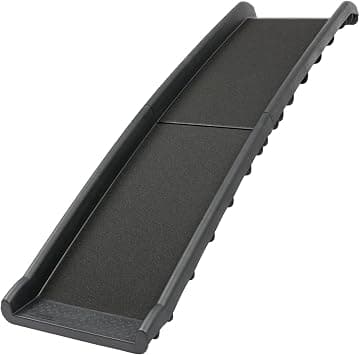
PetSafe Happy Ride Folding Dog Ramp
The right ramp for a car, and the wrong one for a truck. At 62 inches it holds a car sill of around 20 inches at roughly 19 degrees, about as gentle as a portable ramp gets, and at 10 pounds one person lifts it in and out one-handed. Push it up to a 28-inch SUV sill and the angle goes to about 27 degrees, which is where the reason for buying it disappears. PetSafe rates it to 150 lb and lists it at the same price the Amazon listing shows, so there is no marketplace premium on it.
We may earn a commission on this link. It never changes the ranking.
- Length
- 62 in, folds in half to 31 in
- Width
- 16 in
- Height in use
- 4 in deck
- Weight capacity
- 150 lb
- Ramp weight
- 10 lb
- Surface
- High-traction tread, side rails, rubber feet
- Angle at a 20 in sill
- About 19 degrees
What works
- Genuinely gentle against a car boot, the height most owners need
- 10 lb, light enough for one person with a bad back
- Folds to 31 in and locks with a safety latch
- Priced at the manufacturer's own list, not above it
What to know
- Too short for an SUV or a pickup without the angle going steep
- 150 lb rating leaves little margin for a large breed
- Bi-fold hinge needs keeping clean of grit
- No length adjustment, so it fits one vehicle well
$129.99
Price checked Sep 21, 2026
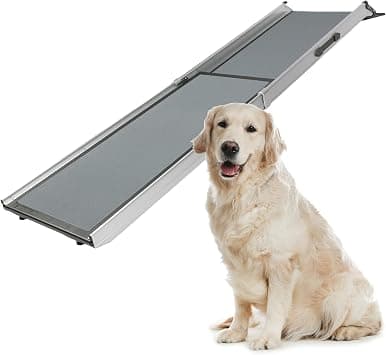
Solvit Deluxe Telescoping Pet Ramp, Standard
The one to buy for a big dog. The 400 lb rating matters less for the dog's weight than for what it implies about stiffness, and a ramp that does not flex under an 80 lb labrador is one the dog keeps using. Telescoping from 39 to 72 inches means it can be set gentle for a car and extended for an SUV. At 72 inches against a 28-inch SUV sill that is around 23 degrees. PetSafe's support documentation for model 62305 confirms the 17-inch width and the 13 lb carrying weight.
We may earn a commission on this link. It never changes the ranking.
- Length
- 39 to 72 in, telescoping
- Width
- 17 in
- Height in use
- 4 in deck
- Weight capacity
- 400 lb
- Ramp weight
- 13 lb
- Surface
- High-traction surface, side rails, safety latch
- Angle at 72 in against a 28 in sill
- About 23 degrees
What works
- 400 lb rating keeps it rigid under a large dog, which is what stops refusals
- Adapts to a car and an SUV rather than fitting one of them
- An inch wider than the folding ramps, which suits a broad-chested dog
- Safety latch keeps it closed in transit
What to know
- 13 lb with a long folded footprint, so boot storage is a real consideration
- At its 39 in setting the angle is steep enough to defeat the purpose
- Telescoping sections collect grit
- More than twice the folding ramp for a job that ramp does well on a car
$169.95
Price checked Sep 21, 2026
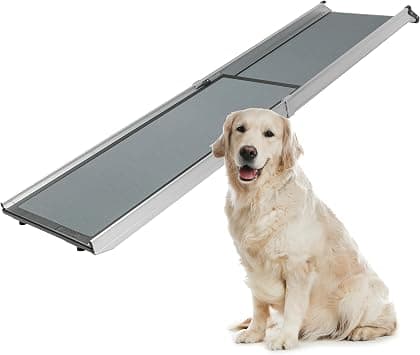
PetSafe Happy Ride Extra Long Telescoping Dog Ramp
The only pick here that solves a truck. Extended to 87 inches it puts a 34-inch pickup bed at roughly 23 degrees, a height every 62-inch ramp turns into a climb of 33 degrees or worse. It is rated to 300 lb, weighs 18 lb, and PetSafe lists it at $179.99 against the $169.95 on Amazon. Buy it only if you have the height, because for a car boot it is 18 pounds of ramp doing a 10-pound ramp's job.
We may earn a commission on this link. It never changes the ranking.
- Length
- 47 to 87 in, telescoping
- Width
- 20 in
- Height in use
- 4 in deck
- Weight capacity
- 300 lb
- Ramp weight
- 18 lb
- Surface
- High-traction surface with side rails
- Angle at 87 in against a 34 in truck bed
- About 23 degrees
What works
- The one length here that keeps a pickup bed under 25 degrees
- 20 in wide, the widest deck in this guide
- 300 lb rating, with the stiffness that implies
- Listing sits below PetSafe's own $179.99
What to know
- 18 lb, and awkward at full extension
- Overkill and over-priced for a car boot
- Needs real storage space even collapsed to 47 in
- The most expensive ramp here
$118.99
Price checked Sep 21, 2026
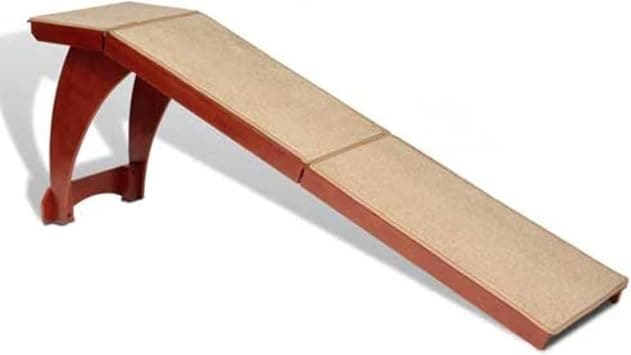
PetSafe CozyUp Bed Ramp, Cherry
An indoor ramp is a different product from a car ramp and this one gets the geometry right. Seventy inches of furniture-grade wood reaching a 25-inch bed height works out at about 20 degrees, the gentlest incline here, and it arrives assembled. The carpet surface is the right choice indoors, where a moulded plastic tread is louder and less grippy under a dog that has just woken up. The linked listing is the cherry finish, 70 by 16 by 25 inches, rated to 120 lb. Cats use it as readily as dogs.
We may earn a commission on this link. It never changes the ranking.
- Dimensions
- 70 in L x 16 in W x 25 in H
- Weight capacity
- 120 lb
- Material
- Furniture-grade wood
- Surface
- High-traction carpet
- Assembly
- Arrives assembled
- Finish linked
- Cherry
- Angle to a 25 in bed
- About 20 degrees
What works
- About 20 degrees, the gentlest incline here
- Carpet surface suits a dog moving on bare boards at 3am
- No assembly, which is rare in this category
- Fixed height means the geometry cannot be set up wrong
What to know
- Seventy inches of ramp is a lot of floor beside a bed
- Fixed 25 in height, so a very tall or low frame is a poor match
- 120 lb rating rules out the largest breeds
- Carpet holds hair and is not wipe-clean
How they compare
| Ramp | Length | Rated to | Angle at its intended rise | Job |
|---|---|---|---|---|
| PetSafe Happy Ride Folding | 62 in fixed | 150 lb | About 19 degrees at a 20 in car sill | Cars and estate boots |
| Solvit Deluxe Telescoping | 39-72 in | 400 lb | About 23 degrees at a 28 in SUV sill | Large dogs, mixed vehicles |
| PetSafe Happy Ride Extra Long | 47-87 in | 300 lb | About 23 degrees at a 34 in truck bed | Pickups and tall SUVs |
| PetSafe CozyUp Bed Ramp | 70 in fixed | 120 lb | About 20 degrees at a 25 in bed | Indoor bed access |
Who each one is wrong for
The folding ramp is wrong for anyone with an SUV or a truck. It is an excellent car ramp and a poor tall-vehicle one, and the failure is arithmetic rather than build quality. It is also wrong for a dog near its 150 lb ceiling.
The Solvit is wrong for a small car and a small dog, where you pay for stiffness never called on. It is also wrong for anyone who will leave it at its 39-inch setting out of habit, since that puts a 20-inch sill at roughly 31 degrees and undoes the purchase.
The Extra Long is wrong for every vehicle that is not tall. Eighteen pounds and 47 inches of collapsed length is a lot of ramp for a sill a 62-inch ramp already handles gently.
The CozyUp is wrong for a household without the floor space and for a dog over 120 lb. It is also wrong for a sofa, where the rise is usually 16 to 18 inches and a 70-inch ramp becomes a trip hazard.
Every ramp here is wrong for a dog that has not been taught to use it, which is a training question rather than a purchase.
The floor around the ramp matters as much as the ramp
A ramp deposits the dog onto a surface, and if that surface is polished boards or tile the dog still has the problem it started with. Traction is not a whole-house project, it is a matter of covering the few feet where a weak grip has to commit: the approach, the turn at the top, and the stretch between the bed and the door. The placements are set out in our guide to where ramps and traction runners actually pay off for a dog with joint pain, and it is worth reading first, because a rubber-backed runner costs a fraction of anything on this page.
The bed the dog lands on matters too. Getting up from a bottomed-out bed asks more of the hips than the ramp beside it ever will, which is why foam density and total thickness decide more about a stiff dog's mornings than the word on the label, and why a bed that has gone flat undoes the rest of the setup. Where the disease is being managed rather than accommodated, whether a joint supplement will do anything for this particular dog depends on the dose printed on the tub, and what the glucosamine and chondroitin numbers need to be is the part most labels leave vague.
Questions people actually ask
What ramp angle is gentle enough for an arthritic dog?
Aim at roughly 20 degrees or below. Divide the rise by the ramp length and take the inverse sine. A 62-inch ramp against a 20-inch car sill is about 19 degrees, the same ramp against a 28-inch SUV sill about 27, and the published kinematic work shows a steep ramp can demand more joint movement than stairs.
How long a ramp do I need for an SUV?
For a sill of 26 to 30 inches, a ramp of at least 72 inches keeps the angle in the low twenties. A 62-inch ramp at that height lands between 26 and 29 degrees, which is steep enough that many dogs with sore hips will balk at it.
Is a ramp better than steps for a dog with joint pain?
A gradual ramp is, because steps require the joint to flex and extend through a real range at each riser. A steep ramp is not reliably better, which is the finding that surprises owners. The advantage belongs to the gradient, not to the format.
Will my dog use a ramp straight away?
Usually not. Introduce it flat on the ground with food, then raise it a little at a time over several sessions until it reaches the vehicle or the bed. A first introduction at full angle, in the rain, when the dog is already anxious, teaches the dog that the ramp is the problem.
Can a cat use a dog ramp?
Yes, and an indoor bed ramp with a carpet surface is frequently taken over by the cat. Arthritis is under-diagnosed in older cats because they hide it by doing less, so a cat that has stopped jumping onto the bed is worth mentioning to a vet.
Sources
- Cornell Riney Canine Health Center on canine osteoarthritis
- Carr JG, Millis DL, Weng HY. Exercises in canine physical rehabilitation: range of motion of the forelimb during stair and ramp ascent. Journal of Small Animal Practice, 2013, 54(8), 409-413
- Kopec NL, Williams JM, Tabor GF. Kinematic analysis of the thoracic limb of healthy dogs during descending stair and ramp exercises. American Journal of Veterinary Research, 2018, 79(1), 33-41
- PetSafe Happy Ride Folding Dog Ramp specification
- PetSafe Happy Ride Extra Long Telescoping Dog Ramp specification
- PetSafe product support for the telescoping dog ramps, including model 62305
- PetSafe CozyUp Bed Ramp specification
As an Amazon Associate we earn from qualifying purchases. We earn a commission on some links, at no extra cost to you. It never changes which products we recommend or the order they appear in. Full disclosure

Who wrote this
Marin Okafor
Editor, dog gear and nutrition labels
Marin Okafor edits PetGearSearch and writes the dog side of it: food, beds, crates, carriers, grooming tools, and the pet insurance policies that pay for the rest. The ingredient panel and the AAFCO statement get read before a single review does, because that back-of-bag paragraph is where two apparently identical foods stop being identical.
The standard
How this guide was built
- The full product specification, ingredient panel or material spec, read end to end rather than summarised from a retail listing.
- The veterinary and regulatory guidance that applies to the category, cited by name and linked — AAFCO nutrient profiles, WSAVA manufacturer guidelines, the VOHC accepted-product list.
- Aggregated owner reviews at volume across retailers, read for the pattern rather than the anecdote, with deliberate attention to the one-star reports where the failure modes live.
- Every price checked against the live listing on the date printed beside it.